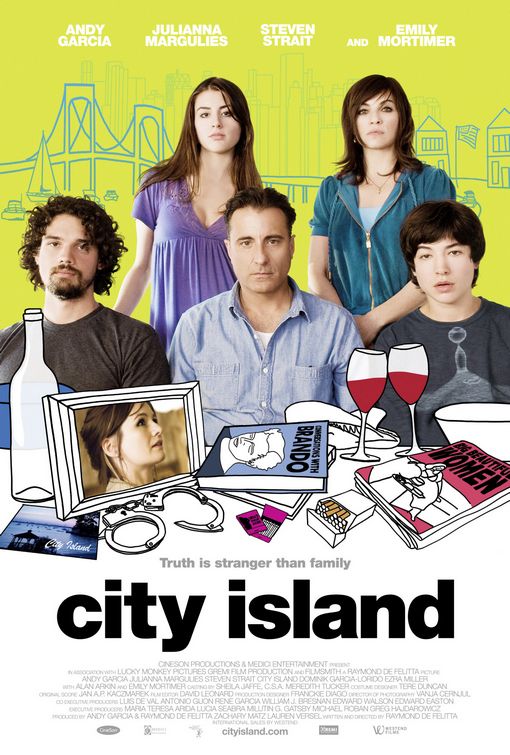
This was in the second row of movies newly added to the Instant Queue. I saw Emily Mortimer's name in the credits, and I kind of find her adorable. Unfortunately, Andy Garcia is top-billed, and that should have been enough to scare me off. It wasn't.
If you want to watch an indie comedy about a dysfunctional family with Garcia and Julianna Margulies as the patriarch and matriarch, then this is your movie. The list of people who that applies to cannot be a long one...
Emily Mortimer was not in this movie enough to offset the pain that the rest of this film causes.
Do you really want to watch a cloying movie in which the charisma-challenged Garcia plays a prison guard who secretly wants to be an actor and finds his abandoned son as an adult in jail and brings him home without telling anyone why? The answer should be no. If it wasn't initially, perhaps once equipped with the information that Garcia also does a Marlon Brando impersonation at an audition because he thinks that's how actors act will scare you off.
I suppose these are the perils of having even more movies available at the touch of a button.
As promised last time, here is the first entrant into what should be a fruitful, if often shorter, additional section to the blog. One in which we (perhaps only royally speaking) look at movies that are available on Netflix Instant Queue and therefore instantly accessible to many of you readers.
The Girl with the Dragon Tattoo is the Swedish adaptation of the absurdly (and arguably unjustly) popular Swedish crime novel by Stieg Larsson. Having just finished the book, I decided to throw this on in the midst of a Netflix-athon with Munch My Benson co-contributor, softitems. Given the freshness of the material, I oddly found myself feeling obligated to explain things, and this was not because of any shortcomings on her part.
Honestly, the film seemed to be a bit of a mess to me. Since the book shared a similar shortcoming, I suppose it only makes sense in the end, but it just felt like there were plot holes. This is largely because the book is an unwieldy material to have to adapt. There are essentially 150 pages before the disappearance of Harriet Vanger is touched on and another 100 after that aspect of the story is resolved. These 250 pages deal largely with the mostly disposable Wennerstrom Affair, but there is also crucial character development of the male protagonist that occurs therein. As this section is largely omitted from the movie, the development of Mikael Blomkvist is sorely lacking. Without this, the fact that Lisbeth (the female protagonist) is drawn to Mikael kind of comes out of the blue.
Given that they are screenwriters Nikolaj Arcel and Rasmus Heisterberg were tasked to adapt a 600 page book, they probably did about as well as could be expected. There is a lot of fat in the novel, and for the most part they trimmed it well. A few characters were combined and the mystery was streamlined a bit. I don't know that I would say the film wasn't worth watching, but I honestly have to say, given its shortcomings, that I am actually curious to see the impending American remake, and you couldn't have said that about most of the American takes on the Scandinavian oeuvre. Given that Steven Zaillian is adapting the screenplay, and David Fincher is directing, I can't imagine it won't be an improvement.
The other thing that struck me while watching the film was, "Wait, I don't remember the Scandinavian peoples as being particularly homely..." Yet, here, frankly, not an attractive cast. Pretty much across the board. Call me shallow, but it made me feel like I was watching a mid-90s BBC production.
Maybe I'm in the minority here, but I just did not get why the book and now the movie are all the rage. They're both all right. The book is readable. The movie is watchable. They are both entertaining enough, but they both seem flawed, and the thing that redeemed the book for me--the interesting relationship between Mikael and Lisbeth--is kind of handled poorly in the Niels Arden Oplev film version.
But it is out there for you to watch. Did anyone out there feel strongly differently?
Inconsiderate Prick Announcement: This post is coming right before the post of a new series I intend to kick off here entitled The Queue Continuumin which I give at least a quick response to something on the old Netflix Instant Queue, which I'd imagine many of you frequenters also have access to. Predictably, the first entrant in The Queue Continuum looks to be the Swedish film adaptation of this very novel, which I watched last week.
I may use that space to open up this space to a few more writers, but I haven't really decided on that yet nor have I really approached anyone about this. You guys probably know who you are, if you see this before I get a chance to talk to you about it, give me a shout/drop me a line.
Despite the fact that we haven't actually met or had a "club" meeting, I sort of read this for an impromptu book club. That isn't to say that I didn't want to read it or hadn't bought it over a year ago, but my desire to read it was met with an approximately equal amount of reticence to pick up something that to me had the same off-putting buzz that The Da Vinci Code had. If that many people are reading something, it can't be good, right?
What made things worse was the fact that every time I was reading the book in public, someone would invariably walk by me every 20 minutes or so and say, "Oh, I loved that book." Rarely was this person someone who struck me as a reader. Is it dickish of me to say this? Yes. Let me refer you to the name of this site. I will simply say that I felt far less self-conscious reading the Grace Kelly bio that I had finished just before this (write-up still to come!) than when I was reading The Girl with the Dragon Tattoo out in the open.
Having gotten those qualifiers out of the way, the book was all right. It was certainly a page turner. Well, the last 350 pages were. While I wouldn't say Larsson's slow open is an insurmountable obstacle, complaints about how nothing happens for the first 200 pages or so are not groundless. There is a lot of exposition and even more character development that could probably be compressed a bit. For the purposes of this novel at the very least, there are multiple characters that are fleshed out much more than they need to be (I'm looking at you Dragan Armansky).
The third-person omniscient narration is probably a misstep at least as much as genre is concerned, as selective insight as to what secondary characters are thinking makes for an unbalanced tale and it does not work for the crime/mystery genre. Why, for instance, do we know what Nils Bjurman is thinking throughout the scenes he appears in while the same treatment is not given to other characters like Cecilia or Martin Vanger? Why are we shown how evil one character is while we are left to guess with others (although it is the inverse of this relation that is more troubling from a narrative standpoint)?
It also isn't a particularly surprising novel. It never felt like plot points came from out of nowhere to surprise you. Harriet's fate seemed obvious to this reader from the start, and frankly this was at the instant Henrik propositions Mikael. It was, in short, predictable.
Larsson's failure to balance the two mysteries is truly the root of the problems with the novel. With two puzzles needing solving, he is ultimately unable to balance the progress toward the respective resolutions well, which leads to roughly 150 pages of arguably needless and certainly excessive exposition for a mystery that then mostly disappears until page 490 or so. When a book is as easy a read as this, it is not impossible to get past this, but the lack of balance to the two narrative thrusts is problematic.
What does work and ultimately can be seen as the novel's redeeming quality are the lead characters, Mikael Blomkvist and Lisbeth Salander. Each character is intriguing enough to want to go along on their journey, and upon being brought together, they play well off of one another despite their disparate personalities. While the novel probably would have been better served without their eventual (read: inevitable) romantic involvement, their relationship still works, and Larsson allows for the bittersweet coda that would not have been in the cards otherwise.
Again, the book is an easy read. For all its shortcomings--and there are plenty--The Girl with the Dragon Tattoo is fairly decent. Whether or not its decided average-ness calls into question its massive worldwide success is another matter entirely, but that really distracts from the point of this exercise.
If you like old Finnish cock, you'll love Rare Exports. If your idea of fun isn't extras from the Lemon Party being thrown into the Finnish tundra nude for 20 minutes, then maybe it would be best for you to avoid Rare Exports.
It was weird in a few ways. Namely, it wasn't really the ludicrous Santa horror movie I was expecting it to be based on the trailer.
It was, however, the movie with the most old cock I can fathom. That's a lot of old cock. And it had it. Holy hell, did it have loads of old, old, old dick. Other than that, all of the action seemed to be in the trailer.
It was a weird little Scandinavian film, with bearded old Finnish dudes naked in the wintry out-of-doors and a kid with a shitty mullet and some other stuff that happened.
So this is kind of a weird week at Inconsiderate Prick. Two trailers for movies that I'm really looking forward to that appeal much more to my high-brow side have found their way into my corner of the enternetz. First it was the Norwegian Wood trailer that I just became aware of.
Then we got the first trailer for next Terrence Malick film, The Tree of Life. Living in Austin, it seemed like every couple of weeks you would happen across someone working on the film in some facet of the process, as Malick lives here and much of the film was filmed in and around Austin. Yes, Malick famously works slowly, but it seems like The Tree of Life went into production fifteen years ago, yet we all wait.
This all matters, of course, because there may not be another filmmaker alive who can bring me to my knees (in praise, not a sexual way) while watching his films without sound. Without the bells and whistles of other auteurs, Malick works in his quiet pastoral realm, preferring to turn his contemplative gaze to building mood. His films captivate you with running time not mattering at all because time is a concept that does not apply to you while watching a Malick film.
Judging by the trailer, The Tree of Life should ably follow in the footsteps of his already stunning catalog. Without further ado...
Next week, I won't have been pulling a 28 hours of work over 36 hours, killing my Wednesday and Thursday. There is a bit of catch up to do, and I've got some ideas for some year-end columns that may or may not happen. Stay tuned.
This topic may seem to be straying from the norm of this blog, but at this stage it's my intention to have my [sporadic] entries be somewhat of a diversion from the norm stylistically and content wise, but still deal with cultural elements at the same time a la an Andy Rooney on 60 Minutes type. And for the majority of the readership, facebook is very much a part of our cultural fabric.
I’ll be the first person to admit that I spend a great deal of my day on facebook. I’d be in complete denial if I tried to say anything otherwise. But, to be fair, most people in my demographic group are on facebook quite a bit. My days are spent in front of a computer, and on my computer, I have facebook up A LOT. Being in my mid 20’s, I remember when facebook first came out, then begrudgingly joining (back when you could only join if you could verify your college-issued email account), which was followed by not checking my email without subsequently going to check my facebook account. Throughout my college career, facebook was a regular part of my day.
Then I graduated, moved into the work force, and continued the same usage pattern.* When I got to my desk in the morning, I would open up three tabs on my browser window. One was my email account. A second was to stream the Dan Patrick Radio Show (which at 11 would be turned to Minnesota Public Radio’s The Current (because Pandora wasn’t up and running at the point)). The third window was for facebook. Every person that worked in that office building (of a few hundred) had similar internet uses whether they were reading the newspaper, checking stocks, playing fantasy sports, or sitting on facebook.
*We young adults get bad raps from older members of the work force for what seems to be poor work ethics. While I won’t defend the number of people I know who are extremely unproductive, I’ll also be quick to point out that every age group has those people.
See…regardless of age, workers will be unproductive for good chunks of the work day. If I were in management (which I wasn’t), I’d rather have people sitting at their desk being unproductive than standing around away from their desk being unproductive. We all have gotten phone calls that needed tending to or emails that deserved a rapid response. I won’t go any further into that, but you [hopefully] get my point.
So, don’t give my generation a bad name just because you’re too biased to look at your own generation with the same critical eye.**
**Yes, I understand that the likelihood of someone over the age of 35 reading this is slim to none…
Now, I will turn my critical eye to those in my generation. I’m sure people I know probably toss around the term “facebook junkie” as an adjective to describe me. Some might think it’s fair, but I’d beg to differ. How would I describe my relationship with facebook you ask…well…I would consider myself a facebook contributor.
Yes, I’m on facebook a lot, and if you’re facebook friends with me you’ll see that I’m updating my status on what I believe to be a reasonable basis (sometimes a couple times a day, but only on a rare occasion and it’s usually maybe once every few days), I comment on photos, statuses, and walls. My status’ are often what I find to be funny. I’ve been friends with people [notice past tense] who were updating on a more frequent/or equally frequent basis as me, and it was always with stupid shit about their boyfriend or that they were “running to the mall” or something that no one cares about. Obviously, there are people that could care less what I say, but I probably equally care less what they have to say. When I comment on photos, it’s either complimentary or funny (usually the latter), and writing on one’s wall is just an open way of communicating.
In my opinion, a “junkie” is someone who only uses and doesn’t contribute anything of substance. I’m not that person. You “junkies” are the people who are on facebook all the time but never really do anything. You look at people’s pictures, or check in on friends’ profiles, but never actually say anything. You’re an electronic-Peeping Tom. Someday, an episode of Law & Order: SVU will have a story line involving facebook lurking, and you’ll say to yourself “that could have been me.”
Again…I’m on facebook a crap ton, but I like to think I’m giving something back to the community. I’m a contributor because I genuinely believe that there are people out there who find the videos I post equally as funny as I do, or who crack a little smile when I “like” a good picture of a friend and his/her significant other because although I’m writing a guest piece on a blog appropriately named for its creator, I’m a decently nice guy under my [described my some]rough exterior.
If you’re friends with me on facebook and get annoyed with the frequency of status updates…unfriend me…I don’t care. If something like that bothers you, I probably equally dislike you as a person, too. If you take something I said in electronic form (see: without vocal tones) as a complete joke wrong, and stop talking to me, you’re probably too serious for me to actually want to be your friend. And finally, to those of you creepers who came across this entry via the Inconsiderate Prick facebook page, actually heed my advice, and start giving back to the facebook community because I’m tired of being one of the few, the proud, facebook contributors.
Inconsiderate Prick Announcement: The vision here at IP has been somewhat singular for quite some time--well, always--but that is about to change. At least a little. On Thursday, my brother--who regular readers of this blog should know through his commenting activity here, or perhaps even his output at Munch My Benson, if they don't know him personally--will have a guest entry up. I've given him carte blanche to write whatever he sees fit whenever he feels the urge. He is probably (read: definitely) less a dick than I am, but he is funny and will bring a lot to the blog if/when he chooses to grace it with his presence. The entry he has written is a helluva way to start things off. On to the show...
It occurs to me that if a random person stumbled across Inconsiderate Prick for the first two posts this week they would think that this is some world literature blog. How wrong they would be...
Judging by the cover art, you'd think Belva Plain wrote it
From what I can tell, The Eye of the Leopard is not the typical Henning Mankell novel. With my exposure to him having been limited to a couple of the Masterpiece Mystery! Wallander series, it is my impression that he is largely known for being a mystery writer. This may not be entirely accurate, as he has written an assload of material that cannot be shoehorned into the mystery genre, but it still feels like he is largely recognized for the character he created and that Kenneth Branagh (and Krister Henriksson before him, and Rolf Lassgård before him) embodied, Kurt Wallander. Sure, Hankell was on one of the aid boats in the flotilla attacked off the Gaza coast by the Israeli military, and he is married to Ingmar Bergman's daughter, but his Wallander series has been adapted for the screen three separate times, which is absurd.
My decision to read The Eye of the Leopard was based solely on the fact that I wanted to read some Mankell, and it was shorter than Depths, which I also have sitting on the bookshelf. Neither are Wallander books, but I wanted to see what else was out there.
What I got was a novel saddled with turgid pacing with its setting split between inland northern Sweden in the 1960s and Zambia in the 1970s and 1980s. Structurally, the novel opens with Hans Olofson, the protagonist, in the throes of malaria-driven delerium in the late 1980s, and then it splits into two narratives that run in alternating chapters. The first storyline starts with Hans's youth in Sweden and progresses through adolescence and into young adulthood. Running concurrently, there is a storyline starting with Hans's arrival in Lusaka, Zambia, that moves on to his eventual overseeing of an egg farm in remote Northern Zambia.
Mankell uses the dual storylines to work towards two ends: what drives Hans to leave Sweden, and what drives Hans to leave. While what happens in his youth is formative, it does tend to drag on, with each chapter of his origin laying the groundwork for the character but lacking in the gravity that is inherent in the sections that take place in Africa. There is a foreboding looming over all of the Africa portions, and while the action may not be coming quickly, there is at least a tension in these chapters that is not present in the Sweden sections, as we know that the protagonist makes it to Africa.
Largely, the book is focused on Hans's inability to fully understand Africans because of his whiteness. The chasm between whites and blacks proves to be insurmountable, with even the whites with good intentions ultimately being unable to achieve what they set out to do.
Sadly the book is paced just a little too slowly. The fits of violence come just a little to infrequently. The spaces between these outbursts of action is just a little too far. The book isn't so long that this is insurmountable, but it doesn't help things.
All right, so this is sort of filler*, but it's something I'm excited about nonetheless.
*I am working on some other stuff (write-up of a Grace Kelly bio and a Henning Mankell book, for starters), and hot stove has reinvigorated Royalscentricity a bit. Don't worry, the actual start of baseball season will surely kill off any energy I have for the Royals...
Haruki Murakami's novel Norwegian Wood has been adapted by Vietnamese-French director Tran Anh Hung. While reviews have been lukewarm--anything less would be surprising given the reverence of the source material--it is apparently blessed with stunning cinematography.
Perhaps more importantly, the beautiful Rinko Kikuchi plays Naoko, and her performance has been lauded. Known to most of us for her turns in Babel and The Brothers Bloom, Naoko provides her with a rich character to embody, serving as a long overdue follow-up to her Oscar-nominated turn as Chieko Wataya in Babel.
As if Rinko Kikuchi were not enough, Jonny Greenwood has apparently composed the score. Given his phenomenal score for There Will Be Blood, I am curious as to what he has done for this one.
I am kind of excited, as Murakami is one of my favorite authors, and the book was great.
The trailer that follows is not the highest quality that I could find, but it did have subtitles.
The release date in the US has to be announced, but the UK date is March 18th. Hopefully the US date is right around then, too.
Since the last time I saw him, Justin Townes Earle has had quite a lot happen. In the past ten months, he has seen the release of his third LP, Harlem River Blues, was arrested in conjunction with an incident after an in-store performance in Indianapolis, suspended his tour, and checked into rehab. Having taken to the road again, putting his relapse behind him, he stopped by The Parish this past Saturday evening.
This time around it seemed as though the show was perhaps a bit more subdued than his February show inside at Stubb's. The songs seemed to have been slowed down a bit, and it took a bit longer for him to get into his groove in the banter department, but the show was still great. Once he got a few songs under his belt, he addressed what it felt like the whole crowd was wondering about: Rehab. Now I'll have to paraphrase here because it's been way too long*, but Earle said that he loved cocaine and alcohol but that he wasn't any good at doing either. It was a direct way to deal with the issue, but successfully diffused any tension regarding the issue with laughter.
*I wanted to write this when I got back that night but didn't get around to it. This is both good and bad, as the video embedded throughout the post surely wasn't up when I would have written this had I been concerned with timeliness, but now I can't quote what he said exactly. Or maybe I can...
Now as for the rest of the show, it was pretty great. Not only did he own the material from his own growing catalog, but he covered Townes, Lightnin' Hopkins, "Union Square" by Tom Waits, and closed the set (if memory serves me correctly) with "Can't Hardly Wait," but the moment that set the show apart from most was his transcendent a capella rendition of "Louisiana 1927" seen below. See for yourself and tell me you're not convinced.
To me, there may not be a burgeoning artist on the scene that has me more excited for their future than Justin Townes Earle. Yes, he's released three LPs and an EP, but all of this output has come since 2007. His show on Saturday was fantastic to be sure, but there was more than that. It held promise and gave me hope that Justin Townes Earle can continue to best his demons and deliver albums and shows that mean as much to me as the ones he has done over these brief few years.
Note: I do feel like this post owes a great debt to The Triggerman over at Saving Country Music, whose videos from the show at The Parish give this entry life. His review of the show is also glowing and should absolutely be read.
I initially started writing this post as soon as I finished watching the series premiere. I fell asleep while writing it and never really came back to it until it was far too late. This is probably for the best.
You see, I have begun to think that maybe it is best if I do not comment on shows until seasons have run their course. Sure, there will be exceptions here and there, but as someone who primarily watches serialized television, it always feels like I'm writing about the first three chapters of a book or the opening act of a movie when I write about a pilot or season premiere of a show with season arcs.
*****SPOILERS ABOUNDING*****
The first season of The Walking Dead, a Frank Darabont produced adaptation of the synonymous comic book series,completed its six-episode run last night. Its premiere was pretty damn great--essentially a Southern gothic retelling of 28 Days Later. There were these oddly soothing almost pastoral scenes cut into the madness that the Rick Grimes (played by Andrew Lincoln*) awakens from a coma into. It also contained the most affective scene in the entire first season, one in which the man who first comes to Rick's aid tries to pull the trigger on his zombified wife. This moment successfully elucidates what the world has devolved into, with Morgan's pain as he trains the sight on her tearing your heart out.
*Who I luckily did not remember from the particularly cloying and distastefully saccharine Love Actually that I have apparently mostly blocked out to protect myself from repeated harm. Instead, when I started watching, it just felt like I was watching a guy who was channeling Josh Lucas, which I can deal with.
The similarities between the pilot, "Days Gone By," and 28 Days Later are pretty obvious, and it was really hard to watch the episode without linking the two. Things could be worse, of course, but the familiarity of the protagonist's circumstances didn't help make things feel fresh. The thing that set it apart was the fact that he was also searching for his family, who he believed to still be alive. He sets off for Atlanta from the rural Georgian county that he was a sheriff's deputy in and finds it to be in the throes of a full-blown zombie apocalypse. After being cornered and trapped inside a tank, he is contacted via short-wave radio by a looker-on.
The second episode picks up at this point, and Rick ends up joining with a group of survivors, helping them orchestrate their escape from a hairy situation in the city. Now, despite the similarities between the Danny Boyle zombie masterpiece 28 Days Later and the pilot, it was a rather compelling 70 minutes, and there were few problems. The second episode is solid, but it seems like after the first episode the pacing is a little off. By the beginning of the third episode, he has already found his family because the group of survivors that came to his rescue in Atlanta were running a scavenger mission for a camp in which his family was staying in. This coincidence is a little too convenient, and it seems like Darabont and the writing staff probably should have drawn out his quest for his family a bit longer. After all, prolonging his search only builds the dramatic tension and creates a deeper conflict when he reappears to a wife who has been sleeping with his former partner.
These second and third episodes are interesting. I may have issues with the pacing being too brisk, but the first three episodes are pretty strong. The fourth episode, "Vatos," was simply not that good. The hostage exchange storyline and the ensuing discovery of the elderly and infirmed colony is basically a dead two-thirds of an episode. Nothing interesting happens until the camp is descended upon by a bunch of walkers as the guys are re-approaching the camp. In the penultimate episode, "Wildfire," too much time is dedicated to the Amy/Andrea storyline, and then it is discovered that Jim (essentially a 'red shirt') was bitten in the attack. Both of these stories consume the episode. It certainly seems like this series is going to be centrally concerned with how we hold onto what makes us human in circumstances as dire as these. I get that much of what I'm complaining about in the fifth episode is doing just that, but it is simply not that interesting here, especially Andrea's near catatonia while she waits for Zombie Amy to arise.
Then comes the finale... The only part that stuck out as being extraordinary was the flashback sequence in the beginning of the episode, showing Shane in the hospital trying to evacuate Rick. While he's trying to take Rick out, the military is massacring innocent people in the hospital. Showing what actually happened as things reached the boiling over point seemed like a harbinger of doom, looming over the entire episode, was probably the most interesting part of the last half of the season.
As the season comes to a close, everything looks pretty damn bleak. Their hope is extinguished as the CDC blows up (crappy effects), and they are left to move on. Aimless. With survival being their only objective.
While there probably needed to be at least two other episodes placed before the third episode, the first season was certainly solid enough to keep watching. It had its flaws, but Andrew Lincoln is a compelling lead, and let's face it, there aren't any other zombie shows on the tube. Until there are, this is probably the only place we'll be able to get our fix.