While it wasn't for everybody, I actually liked the first installment in Guy Ritchie's Sherlock Holmes series. The energy between the three lead actors--Robert Downey, Jr., Jude Law, and Rachel McAdams--was intoxicating, and their banter was engaging.
Unfortunately, nearly everything that worked in the first one is absent from Sherlock Holmes: A Game of Shadows. The witty banter is largely missing. The chemistry between Downey and McAdams is gone because she is taken out of the picture in the first ten minutes. She is replaced with the leaden Noomi Rapace, whose Roma fortune teller brings little to the tale. The dialogue between the rakish Holmes and Watson lacks the verve that was present in the first.
And despite the fact that he's finally facing off against the supervillain, Dr. James Moriarty (played effectively by Jared Harris), the action sequences, especially the one in the woods, are so obfuscated by Guy Ritchie's infatuation with that herky-jerky, computer-generated, stop-and-start editing of action set pieces as to have been rendered completely unintelligible.
If you liked the first one, this is quite a let-down. If you didn't, you'd like it even less.
Having seen the bulk of Woody Allen's directorial output over the past two decades, I can say with little trepidation that Midnight In Pariswas the most enjoyable film of his since at least Sweet and Lowdown. In fact, this was such a triumphant return to form that it forced, if only for a moment, the question into my mind as to whether Woody Allen had made a film this good since Manhattan. That Midnight In Paris forces these thoughts speaks volumes.
The primary problem with most of Allen's films over the past 15 years (and really, this could be said of everything he has done since the mid-1970s) is that they are essentially all the same three or four films. His big stand-out film, Match Point, was all fine and dandy--unless you had seen Crimes and Misdemeanors within the fifteen years prior to having seen Match Point.
With the exception of the fact that Allen's protagonist is in a relationship that is unfulfilling but is not entirely aware of the fact that it is not meeting his needs, this is a different film. A time-travel movie. A literary movie. A love letter to Paris. An historical comedy. A film about romanticism and its trappings. It is all of these things and so much more.
Perhaps the fact that I majored in English Literature factors in too heavily to my love of this film, but its ventures into the world of The Lost Generation and the Belle Epoque bring icons from history to life with such vivacity and attention to detail that it is nearly impossible not to marvel at. For proof, one need look no further than Corey Stoll's brilliant turn as Ernest Hemingway. Every word that comes out of his mouth, every turn of every phrase is the perfect distillation of Hemingway's treatises on the masculine ideal delivered in a way as sparse and direct as if Hemingway had written them himself. And it is hilarious. Every time Stoll opens his mouth gold comes out. There are other 1920s and 1890s Parisian cameos, but Stoll's Hemingway would be enough to carry these portions by itself.
Luckily that is not necessary. Midnight In Paris affords Owen Wilson an opportunity to return to the sort of character that suits him best. With a few exceptions, Wilson has spent the past decade chasing commercial success as a leading man in mainstream comedies. This typically means he is cast into roles that do not cater to his strengths, ones that don't relish in insecurity and pathos. Here, Wilson gets to channel what appears to be his inner self, the self he wrote parts for in Bottle Rocketand The Royal Tenenbaums. For Owen Wilson, much like Woody Allen, Midnight In Paris is a return to form, reminding us of the promise that once seemed to be boundless.
Wilson plays Woody Allen, at least if he were a screenwriter attempting to write his first novel. He is engaged to Inez (played by the always comely Rachel McAdams), who just wants her fiancee Gil to settle for a career path in which money and security take precedence to chasing something creatively stimulating. Gil is a dreamer, an idealist, a romantic. Inez is an uninspiring pragmatist. As they kick around Paris, both with her conservative parents and her pseudo-intellectual college friend Paul (the pitch-perfect Michael Sheen), he finds himself extracting himself from social situations to roam the city at night. As he gallivants around Paris, he finds himself transported back to the era he's so enamored with each night at the stroke of midnight. It is not bogged down with quantum mechanical explanations for the time travelling. This is light-hearted fare.
What really matters though is that Allen's love for character, city, and history comes through at every moment. The art history and literary influence is not simply for the literati but enrich the film throughout without feeling inaccessible. Allen has made his first great film of the new millenium.
It is nearly impossible to go into Sherlock Holmes without a healthy amount of trepidation given that Guy Ritchie is at the helm. Eleven years ago, he seemed to establish himself well with his great debut feature-length film, Lock, Stock, and Two Smoking Barrels. His second film, Snatch, was still a good time but was lacking in originality, as it was essentially mining the same territory with a higher budget and star-studded cast.
After that, he married Madonna, made the universally panned departure from form Swept Away, tucked his tail between his legs, went back to ripping off his own first film--only this time it was like the later Michael Keatons in Multiplicity and the virtually unreleasable Revolver and RockNRolla came out.
With the knowledge of his career path inescapably holding firm to my subconscious, I still held out hope for Sherlock Holmes to be good.
I am happy to say that my hope has been validated.
Perhaps it was that Ritchie, whose issues have never really been on the technical side of the directorial duties but rather on the storytelling side of things, has finally helmed a film that someone else wrote. The presence of other minds at work on the narrative end of things is welcome here and protects against a singularity of vision that had seemingly stagnated his growth as a filmmaker and resulted in a decade of disappointing output.
Perhaps it was that Ritchie surrounded himself with a fresh set of actors. In addition to the four collective Academy Award nominations of Jude Law and Robert Downey, Jr., the adorable firecracker Rachel McAdams graces the film with her presence. If she made ten movies a year, it still wouldn't be enough for my liking. Jude Law finally gets off the five year box office poison wave he had been riding and shows us what we had been missing out on while he went through his own career hiccup. And Downey? Well, by my count he's done at least seven solid-to-great movies in since 2005 (mostly great) and seems to be touched with quite the bit of good luck. Guy Ritchie could certainly have done worse than this cast, and I'll surely talk about this a little more as we go. Before we move further, here is the trailer to serve as a refresher:
Now, I'm just going to come out and say this: Of all of the big movies that came out last year, I'd have to say that Sherlock Holmes left me the most satisfied. It should be noted that I'm no Sherlock Holmes purist. I'm not some bizarre Holmes fanboy. I can only tell you what I liked.
Guy Ritchie has clearly surrounded himself with the right cast and crew to fully realize his vision for this film. As for that vision, he gives the audience a look at a very dirty London apparently right around the turn of the 20th Century. The London brought to the screen here is thoughtfully and meticulously conceived and spectacularly, fully realized.
From a camera work standpoint, Ritchie's signature, stop-and-start, rotationally-inclined edits are used sparingly and are not shoe-horned into sequences in which they are not appropriate. In fact, it is actually only incorporated when Holmes, who clearly processes things faster than the average fella, has slowed things down and worked out a plan of action that he is about to set off upon, so it actually fits fairly well within the context of the film. When those sequences replay in quick time, they work as well. For once, it seems as though these visual flairs are not just for show, but rather that they serve a function that is complimentary to the narrative.
As for the Holmes/Watson dynamic, there are certainly the undertones of sexual ambiguity, but the most important element of their relationship is strong. Watson is to Holmes as Wilson is to House. Here, they both happen to be badasses with an ability to fight, but unlike some of the hokier Sherlock Holmes films Watson is a man not to be trifled with.
I have heard some complain about the boxing sequence in the early goings as seeming like it was Ritchie trying to force a scene playing to his filmic wheelhouse into the film, but I beg to differ with that assertion. Throughout the film, it seems as though Holmes is seeking out adventure almost as much for the sport of it as anything else. As boxing was the sport of the time, it makes sense that the thrill-seeking Holmes would step into the ring to fight. Now, Holmes's* use of Brazilian jiu-jitsu may seem like it is potentially out of place, but barjitsu (jiu-jitsu for all intents and purposes) is apparently present in Sir Arthur Conan Doyle's The Return of Sherlock Holmes.
*Fuck AP style. I'm using apostrophe-s when a singular noun ending in the letter 's' needs to be possessive.
Back to the acting, Downey has been rock-solid pretty much since Kiss Kiss Bang Bang and has been otherworldly good in at least* three of his past four films. His turn as Sherlock Holmes fits in well amongst Tony Stark and Kirk Lazarus (which truly is amazing--I never think about how that is Downey in blackface). He perfectly embodies Holmes at his most incorrigible, brilliant, drug-addled, and inquisitive.
*I have not yet seen The Soloist. I suppose it, too, could contain a great Robert Downey, Jr., performance, but I can't say I'm insanely psyched about seeing that film.
Really, with Downey cast as the lead, it was going to take a minor disaster to have the film run off the tracks. Given Ritchie's ten-year track record, the likelihood of that minor disaster actually taking place was much, much higher. Luckily for all involved, disaster was averted. In fact, it was never even close to being disastrous. Instead, Guy Ritchie has an international hit on his hands, and Robert Downey, Jr., would seem to be the star of another lucrative film franchise.

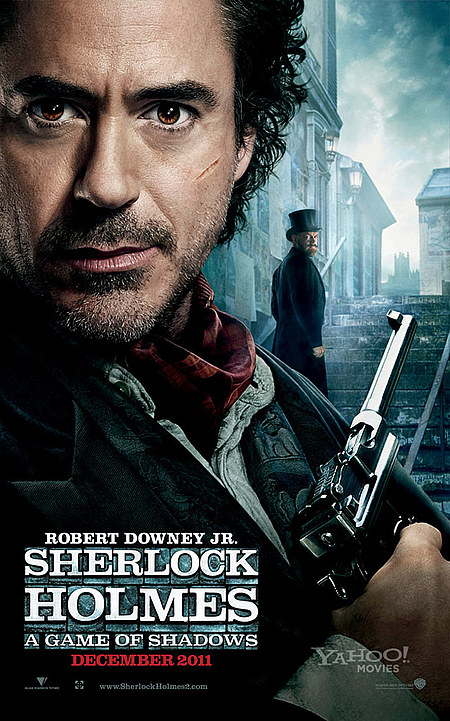 While it wasn't for everybody, I actually liked the first installment in Guy Ritchie's Sherlock Holmes series. The energy between the three lead actors--Robert Downey, Jr., Jude Law, and Rachel McAdams--was intoxicating, and their banter was engaging.

 was the most enjoyable film of his since at least
  . In fact, this was such a triumphant return to form that it forced, if only for a moment, the question into my mind as to whether Woody Allen had made a film this good since
  . That Midnight In Paris forces these thoughts speaks volumes.
 , was all fine and dandy--unless you had seen
  within the fifteen years prior to having seen Match Point.
 and
and  . For Owen Wilson, much like Woody Allen, Midnight In Paris is a return to form, reminding us of the promise that once seemed to be boundless.
