Monday, October 10, 2011

Man on Film: The Ides of March

George Clooney's fourth time out as a director sees him stepping back into a more serious realm after his middling football romp Leatherheads. While not reaching the heights that he soared to in Good Night and Good Luck--the best film of 2005--it is hard to fault him for not making a masterpiece this time around.

What The Ides of March is about at its core is Junior Campaign Manager Stephen Myers's loss of innocence. The brains behind the campaign, Stephen (played by the ever-impressive Ryan Gosling) embodies the idealistic crusader that so many wide-eyed and hopeful young people getting into politics are. In Governor Mike Morris (Clooney), Stephen believes that he has found his man, the one that can make a difference. Morris is the filmic equivalent of Jed Bartlett or Matt Santos, a paragon of liberal virtues and ideals in the form of an attractive and charismatic man. In other words, Morris is a dream candidate.

Unfortunately, Morris is a human being and is therefore imperfect. As Morris's imperfection becomes an issue, Myers begins to chip away at his own innocence. With both Senior Campaign Managers--of Morris's campaign, Paul Zara (Philip Seymour Hoffman) and that of his Democratic Primary rival, Tom Duffy (Paul Giamatti)*--serving as cautionary examples of what cynicism-riddled existences a life on the campaign trail can produce, the future that awaits Stephen is prominently featured throughout the film. His path is sealed by the course of action he takes at each crossroads. As he gets deeper and deeper, he loses more and more of himself.

*The Ides of March is unique in that is likely the only movie that will ever be made requiring the acting talents of both Paul Giamatti and Philip Seymour Hoffman. It must have been odd for the two of them to not be competing for the same role, as there are actually two homely, unscrupulous, manipulative pricks who want to win at all costs in this film.  

Stephen's devolution is representative of the inevitable death of idealism in politics as winning takes precedence over maintaining the moral high ground. Governor Morris, too, is required to sacrifice his principles for the prospect of winning. To say that this film holds little hope for the ability of idealists to traverse the treacherous and rocky terrain without losing touch with what they believed in prior to entering into the fray is an understatement.

On these points, the film works. If you were looking for any sort of political intrigue or an unpredictable plot, this isn't your movie. While the central concern of the film is what happens to Stephen Myers, the course that the campaign takes through the Ohio Primary is obvious from the moment Evan Rachel Wood walks across the screen. The campaign is secondary to Stephen's descent, but it still fails to surprise from a narrative standpoint. While one could hardly qualify the campaign as dead screen time, it definitely seems to do little but serve a purpose to forward a single character's story arc.

The film does look great, set against the bleak landscape of the Rust Belt in March, and is carried by great performances from Gosling and Clooney with Hoffman, Giamatti, and Wood holding their own. Clooney, who also co-wrote the screenplay, clearly has an aptitude for crafting a film imbued with strong liberal ideals, as all of Morris's speeches on the campaign trail would have been right at home in the Sorkin-helmed seasons of The West Wing. For the most part, he's got another great film on his hands, although its not flawless like Good Night and Good Luck was.

Wednesday, October 5, 2011

Reading Rainbow: Palo Alto by James Franco

Somewhat predictably, I read this book. After all, I did record a large chunk of the General Hospital run he made. Weird to say the least.

It's been months since I finished this book, but that's just how things have been flowing out here lately.

For those unfamiliar, Palo Alto is a collection of short stories penned by the modern-day Renaissance man set in his hometown of Palo Alto in the early-to-mid-1990s. Set amongst high schoolers whose lives occasionally intertwine in these stories, Franco makes the rounds through different teens' lives, always stepping into their shoes in the first-person. If one subscribes to the notion that teens aren't particularly complex, then Franco is able to convey the alienation and insecurity implicit in being a teen.

His vision/recollection of teen angst is a bit bleak, with his characters routinely exposed to senseless crime and emotionally disconnected sex, but is this really that far off?

Where he does come up a bit short is in the fleshing out of the characters. While the voices do at times seem to come from unique people, their narration does not ring in any meaningful way as stylistically dissimilar from one another. Furthermore, when attempting to take on the voice of a female, Franco has the same issue that many male authors have when trying to embody a female voice in prose: it rings inauthentic. While it is difficult to fault a male scribe for being able to accurately pen the dialogue or first-person narration from a female's perspective, the fact remains that the attempt was made and said attempt was by and large unsuccessful.

While not quite hitting it out of the park, Franco's first foray into the realm of fiction is at least an admirable attempt. Those who are inclined to read this probably will. Those who want to hate this because an actor wrote this probably will as well. Objectively, this is a perfectly readable collection of short stories with at least some merit, if not pulled together completely. There is enough here to at least be curious as to where his literary path will take him.

Tuesday, October 4, 2011

Man on Film: Contagion

Contagion is a cautionary tale.

Succinctly, this movie is about what happens when Gwyneth Paltrow commits adultery. She cheats on Matt Damon, and the fucking world goes to hell in a hand basket.

Who would cheat on Matt Damon?

I know I wouldn't.

Thanks, Paltrow.

Thanks a bunch.

Oh, and wash your goddamn hands when you're handling meat, kitchen peeps. Even if you're shaking hands with a harlot. Your pork hands could kill the whole world.

And let me tell you, it was weird seeing my old hood torn apart by the new plague, and Kate Winslet was held in the old Armory at my alma mater.

She didn't need to die, Gwyneth.

You just had to get your rocks off, didn't you?

Monday, October 3, 2011

Man on Film: 50/50

To anyone paying any attention over the past seven years, Joseph Gordon-Levitt has been attempting to establish himself as one of the rangiest young actors working. Starting at Manic and working your way through Mysterious Skin, Brick, Havoc, The Lookout, and Uncertainty, he has enough indie cred to keep most actors sated for a career and has covered a wide breadth of character types. 50/50 is a nice addition to his resume, one that he took on less than two weeks notice when James McAvoy had to pull out. His lack of time for preparation does not show at all.

Coming from a screenplay by Will Reiser (Paul's cousin) based on his own experience with cancer, Gordon-Levitt plays Adam, a 27-year-old public radio writer who finds out that he has neurofibroma sarcoma schwannoma, a rare cancer that attacks the nervous system (in this case, his spinal column) of people who have genetically inherited susceptibility to the disease. Despite living a safe and clean lifestyle, he finds his world falling apart.

While this premise could certainly go the way of the painfully melodramatic, the film manages to pull off the dicey proposition of being a successful cancer comedy. Throughout the film, the comedy seems to come naturally; hell, the whole film seems to unfurl organically. Humor, joy, pain, anger: all of these things are character-based. They never come across as even remotely forced, and there is a tone struck early that director Jonathan Levine sticks to throughout.

As usual, Joseph Gordon-Levitt is fantastic. Somewhat shockingly, Seth Rogen pulls off the somewhat dramatically demanding best friend role with aplomb. Bryce Dallas Howard and Anjelica Huston are well cast for their supporting roles, and the impossibly cute Anna Kendrick shines as the green therapist feeling her way through treating her third patient.

What 50/50 is is a smart, character-driven comedy dealing with a serious issue that touches just about everybody's lives. And it has a Gerry Rafferty song on the soundtrack, which speaks volumes.

Wednesday, September 28, 2011

The Queue Continuum: Buried

I had wanted to check out Buried while it was in the theaters but never got around to seeing it. Obviously, this urge was driven by my Ryan Reynolds fandom, which many would classify as irrational or inexplicable.

Needless to say, when faced with a Sunday in which I awoke at 7:00 AM with nothing on the docket for my only day off of the week, I queued it up like John de Lancie.

I can say without reservations that this is arguably Reynolds's finest hour, at least until the Deadpool movie happens. Sure, he's his funny self in Waiting..., Van Wilder, and Two Guys, A Girl and a Pizza Place, an amiable father in the underrated Definitely, Maybe*, and an apt sleazeball in Adventureland, but he had not been previously required to take on a role like that of Paul Conroy in Buried.

*Perhaps it's no coincidence that both the movie and the Oasis album of the same name are underrated. The title doesn't help much, as it seems unable to assess itself, but the movie (which I've written about here) and the album are both damned entertaining. I'd certainly say that the Oasis album is superior, but I could throw either on and be happy.


Coming to in a slipshod wooden coffin buried in the Iraqi desert, Conroy is stripped of everything but a Blackberry, a Zippo, his flask, and some lights. What follows upon his regaining consciousness is an exercise in claustrophobia that does not relent and would surely have induced unbearable unease had I actually seen it in the theater.

Relatively unknown director Rodrigo Cortes never lets his camera leave the box. What unfolds is a suspenseful one-man show that drives anxiety and fear to great heights. It may not reach the apex that 127 Hours does, but it succeeds in surpassing the likes of Phone Booth, whose sense of claustrophobia simply isn't as fully realized.

It's at your beck and call. Be not afraid.

Monday, September 26, 2011

Man on Film: Moneyball

Adapting Moneyball into a film was a loaded proposition. Amongst certain circles, this book was (and to an extent still is) a bit controversial. As someone who stands somewhere vaguely nearby these circles, this was bound to be a somewhat divisive film. It was divisive for me.

On a fundamental level, the film fails to drive home the misunderstood central point of the book. The movie sort of touches on it, but what the book was really about the A's success as a result of exploiting market inefficiencies. Jonah Hill's Peter Brand character (the Paul DePodesta stand-in) hints at the larger issue when he is talking with Billy Beane (Brad Pitt) in their conversation in the parking ramp but doesn't go much further than to say that Major League Front Offices were in the Stone Ages.

Unfortunately, Moneyball the film ends up being an oversimplification of the scouts versus stats debate with an extremely one-sided take on the issue. The scouts are painted as stodgy old men unable to stomach a challenging of the status quo or to adjust to any sort of change.

From a baseball nerd's standpoint, this was a bit of a disappointment.

Having said that, the movie itself was pretty good. While some of the deviations from the book may bother those who read it, artistic license is obviously employed for the sake of streamlining the story and dramatic effect. The changes are understandable, as elements such as the draft had no bearing on the season itself. Working with a Steven Zaillian draft, Aaron Sorkin's presumed polish on the dialogue definitely shows, and Moneyball is rife with humor. The film looks pretty good, although the occasional departure from realistic shooting during some of the baseball sequences was sort of irksome. Not surprisingly, Brad Pitt carries the film, and Jonah Hill ably pulls off being his complement.

The seemingly universal acclaim seems a little surprising but is mostly from the general public with the baseball community seeing the film as much more of a mixed bag. Personally, the film was solid but not spectacular, and it was a bit difficult to separate the book from the filmic interpretation of the book.

Thursday, September 22, 2011

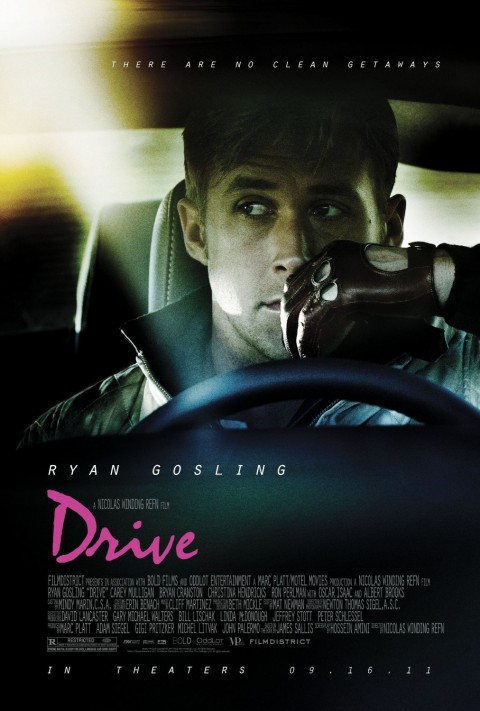
Man on Film: Drive

Holy fucking shit.

Really, those three words could aptly sum up my reaction upon walking out of the theater after seeing Drive. Remember a little while back when I credited TSLF with pointing out that you kind of trust Ryan Gosling at this point. Drive sets this in stone.

In Drive, Nicolas Winding Refn has crafted an action film that sits down and makes itself at home in the ordinary. Much of the first half of Drive does little more than follow Gosling's nameless Driver in his day-to-day life. He drives around Los Angeles, does a stunt on the set of a film, goes grocery shopping, and goes to work at the auto shop.

While Refn revels in the mundane, he sets these scenes against the sonic backdrop of Cliff Martinez's ethereal score and a smattering of synthed up electronic pop gems hearkening back to the 1980s. When combined with Driver's oft-out-of-time attire (namely his killer scorpion jacket) and the neon titles, the film manages to feel as if it is happening in a time unbound to a single era--both now and in the 80s--almost as if it were a dream.

It is in this dream- or trance-like state that the Driver seems to operate within. This is evident early on. After getting his wheel man spiel via voice-over, we see Gosling waiting curbside for two men pulling off a heist seen in part here:

Throughout the film, Gosling affects a calm that nearly spills over into aloofness. He is the modern Spartan. For the most part, he speaks in simple sentences and only when addressed. The one time he does speak at length, his wheel man spiel, comes via voice-over, so it is almost as if his only lengthy lines of dialogue come from the ether.

It is this tone that is struck in the majority of the opening half of the film that makes the violence that ensues in the second half of the film so jarring. The calm that pervades the film early on is broken suddenly and shockingly, and the random intermittence at which it explodes keeps the audience on edge. This is what sets Drive apart. Nicolas Winding Refn sets a tone to make the violence resonate. It can come at any time, and it goes just as fast as it came. And the driving scenes are unique in that Refn keeps the focus tight on the Driver, which causes a much more personal reaction to the sequences.

Now, the way that I've talked about the film makes it seem like acts of violence just break into an otherwise dreamlike movie about the mundane. There is a healthy dose of comedy and lightheartedness mixed in, just enough to sprinkle in a little levity.

As for the acting, Bryan Cranston, Ron Perlman, and Christina Hendricks are all perfectly fine. After what seems like at least a decade since Albert Brooks has had a role to do anything with, he gets his Robert Forster in Jackie Brown opportunity and relishes it with elan. As for Carey Mulligan, she plays an endearing quasi-single mother injecting a gentle humanity into the core of the film.

And then there's the star. As always, Ryan Gosling brings it. His performance is reminiscent of Brando or McQueen. He says next to nothing yet the camera is almost always focused on him. His scenes with Irene (Mulligan) and her son, Benicio (Kaden Leos), are great and he gets to show a slightly goofy side. When it comes time for him to unleash hell, he is up for the challenge.

All in all, what Refn has crafted is a stellar action piece that vacillates between a near-dreamlike state and storms of action and violence with unpredictability. It is also one of the best films of the year.

Monday, September 19, 2011

Man on Film: Shark Night 3D

Take Piranha 3D.

Subtract all the cheeky, self-aware/-deprecating humor.

Extract all the wit.

Waste Donal Logue.

Excise the massive amounts of nudity.

Take everything else good away.

Then turn what's left into something worse.

You now have Shark Night 3D.

What a fucking waste.

Of time.

Of celluloid.

Of money.

Of Time.

Here's a trailer. Watch it if you want to, I guess.


Friday, September 16, 2011

Reading Rainbow: The Death of Bunny Munro by Nick Cave

I like Nick Cave. A lot. Enough to travel from Austin to Portland to see him (with the Bad Seeds) in concert. The Death of Bunny Munro was a tough read.

Perhaps it was the fact that I was reading this simultaneously with Bukowski's Post Office, but reading something that made me feel like an unforgivable bastard just for being equipped with male genitalia is not the most appealing proposition. The titular character is loathsome. He is controlled by his id, chasing tail recklessly (and often reprehensibly) across the pages of the novel. Surviving his wife (whose suicide can largely be pinned on his wanton skirt-chasing ways), he brings his son along on the road with him while he makes cosmetics sales calls. He unravels, but the voyage is simply tiresome.

Upon finishing the book, the only feeling left is relief at not having to read any further, which is sad because Cave has such a penchant for writing compelling music leaving you wanting more.

Thursday, September 15, 2011

Man on Film: The Change-Up

I guess this is as good a place to start as any in my massive backlog of entries to write. Some may be less long than others, but given the monumental task at hand that has to be expected, if not excused. 

Generally speaking, I like the body-switch comedy. Sure, that affection is driven mostly by an appreciation for camp, but the affection remains. After all, this is the genre that includes Like Father, Like Son, Vice Versa (that link right there is for the the two combined...), 18 Again, and Dream a Little Dream.

With its raunchiness front and center, The Change-Up should have sated my yearning. Adding Jason Bateman and Ryan Reynolds to the mix should have sealed the deal.

Unfortunately, their presence (if you somehow missed it, this guy is a fan of Ryan Reynolds) raises the stakes, and the script/direction doesn't ante up.

There are some funny bits. At this point, The Change-Up is an afterthought anyway. You are probably more likely to see it on TV or video. It isn't completely bereft of comedic value, making it worth queuing up on Netflix when it makes its way there.

As a bonus, Olivia Wilde is in the movie, and it has been scientifically proven that she's a stone-cold fox.

Related Posts Plugin for WordPress, Blogger...