Showing posts with label Ryan Gosling. Show all posts

Tuesday, July 23, 2013

Man on Film: The Place Beyond The Pines

Having thought quite highly of the emotional wrecking ball that was Derek Cianfrance's 2010 breakthrough Blue Valentine and seen nothing but positive buzz about this film, it was nearly impossible to not have high expectations for The Place Beyond The Pines despite going in nearly completely blind.

While there were elements that worked quite well, the film's unwieldy narrative structure--and most importantly its uneven and quite distinct three acts that spanned a 140-minute stretch of time that felt more like 180 minutes--made for a disappointing moviegoing experience.

Much of this owes to the film's strongest section being its first act. If one were looking at the first act as a genre film independent of the rest of the film, it would be difficult to not come away completely enamored with the film. On its own merits, the first act is a brilliant bit of motorcycle B-movie exploitation. Ryan Gosling is every bit the badass that he was in Drive, but Luke Glanton is much more complex than Driver was, allowing Gosling to run the gamut from boyishly charming to unhinged and volatile. In fact, there's almost nothing not to love about this first section of the film. Eva Mendes is surprisingly dextrous as the downtrodden former flame trying to piece together her life on the fringe; the motorcycle stunts are fucking visceral and exhilarating; and the spectacular Ben Mendelsohn knocks his supporting part out of the park.

Unfortunately the first section is only the first section. The film trudges on through two more lengthy acts as Cianfrance explores the theme of the sins of the father permeating their progeny. Each of the subsequent acts drags more than its predecessor, the air is slowly let out of the movie, and by the time we get to the film's conclusion, its impact is diminished by the question nagging the viewer: when will this fucking movie end?

To be fair and forthcoming, there are elements of these latter acts that work. Bradley Cooper does what he can with his role. Just as Luke Glanton is filled with pathos, so is Cooper's Avery Cross. His journey, his conscience, and the ethical dilemmas he faces are all at least moderately engaging. Is Avery's section as electric as Luke's? Absolutely not. Fortunately, Cooper is adept enough to take the audience wincing along with him. Hell, if the film had simply concluded with a little coda after the Avery section, you'd probably have read this review months ago when I actually saw the film.

Instead, Cianfrance and co-screenwriters Ben Coccio and Darius Marder tacked on the third act with Luke and Avery's sons (played by Dane DeHaan and Emory Cohen, respectively) playing out the string as their fathers' sins infect their lives. Perhaps if the sons, especially Cohen, were played by young actors with more gravitas--I'm extremely familiar with DeHaan's work, and he can play emotionally fragile and volatile, but it seems like he lacks the ability to thrive doing anything else--then the film wouldn't have ended on such a sour note. Cohen's performance not only lacks gravitas but is grating. Each line he delivers screams Long Island, well at least when you can understand him through the marbles that he's got lodged in his mouth. Moving past a performance that sticks out so plainly as inadequate, it's hard to say that the film would have been saved with a different actor in the role. The final section would have likely fallen flat regardless of the performances. The Place Beyond The Pines's conclusion is simply too long coming and is almost entirely punchless. Perhaps the final section plays differently if the film hadn't peaked at least 90 minutes earlier. That isn't the movie that we got, though, and The Place Beyond The Pines ends up uneven at best.

The Place Beyond The Pines is available for pre-order on DVD and Blu-ray on Amazon (their release date is August 6th) or you can stream on Amazon VOD as of today. Don't take my word on it. Watch for yourself.

Monday, October 10, 2011

Man on Film: The Ides of March

George Clooney's fourth time out as a director sees him stepping back into a more serious realm after his middling football romp Leatherheads. While not reaching the heights that he soared to in Good Night and Good Luck--the best film of 2005--it is hard to fault him for not making a masterpiece this time around.

What The Ides of March is about at its core is Junior Campaign Manager Stephen Myers's loss of innocence. The brains behind the campaign, Stephen (played by the ever-impressive Ryan Gosling) embodies the idealistic crusader that so many wide-eyed and hopeful young people getting into politics are. In Governor Mike Morris (Clooney), Stephen believes that he has found his man, the one that can make a difference. Morris is the filmic equivalent of Jed Bartlett or Matt Santos, a paragon of liberal virtues and ideals in the form of an attractive and charismatic man. In other words, Morris is a dream candidate.

Unfortunately, Morris is a human being and is therefore imperfect. As Morris's imperfection becomes an issue, Myers begins to chip away at his own innocence. With both Senior Campaign Managers--of Morris's campaign, Paul Zara (Philip Seymour Hoffman) and that of his Democratic Primary rival, Tom Duffy (Paul Giamatti)*--serving as cautionary examples of what cynicism-riddled existences a life on the campaign trail can produce, the future that awaits Stephen is prominently featured throughout the film. His path is sealed by the course of action he takes at each crossroads. As he gets deeper and deeper, he loses more and more of himself.

*The Ides of March is unique in that is likely the only movie that will ever be made requiring the acting talents of both Paul Giamatti and Philip Seymour Hoffman. It must have been odd for the two of them to not be competing for the same role, as there are actually two homely, unscrupulous, manipulative pricks who want to win at all costs in this film.  

Stephen's devolution is representative of the inevitable death of idealism in politics as winning takes precedence over maintaining the moral high ground. Governor Morris, too, is required to sacrifice his principles for the prospect of winning. To say that this film holds little hope for the ability of idealists to traverse the treacherous and rocky terrain without losing touch with what they believed in prior to entering into the fray is an understatement.

On these points, the film works. If you were looking for any sort of political intrigue or an unpredictable plot, this isn't your movie. While the central concern of the film is what happens to Stephen Myers, the course that the campaign takes through the Ohio Primary is obvious from the moment Evan Rachel Wood walks across the screen. The campaign is secondary to Stephen's descent, but it still fails to surprise from a narrative standpoint. While one could hardly qualify the campaign as dead screen time, it definitely seems to do little but serve a purpose to forward a single character's story arc.

The film does look great, set against the bleak landscape of the Rust Belt in March, and is carried by great performances from Gosling and Clooney with Hoffman, Giamatti, and Wood holding their own. Clooney, who also co-wrote the screenplay, clearly has an aptitude for crafting a film imbued with strong liberal ideals, as all of Morris's speeches on the campaign trail would have been right at home in the Sorkin-helmed seasons of The West Wing. For the most part, he's got another great film on his hands, although its not flawless like Good Night and Good Luck was.

Thursday, September 22, 2011

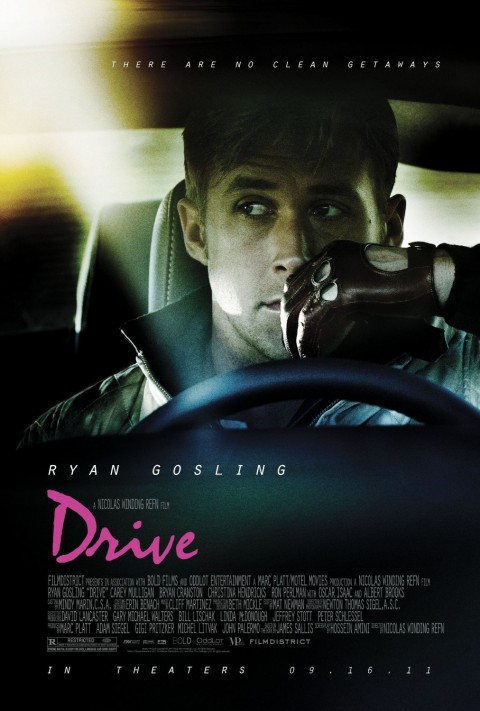
Man on Film: Drive

Holy fucking shit.

Really, those three words could aptly sum up my reaction upon walking out of the theater after seeing Drive. Remember a little while back when I credited TSLF with pointing out that you kind of trust Ryan Gosling at this point. Drive sets this in stone.

In Drive, Nicolas Winding Refn has crafted an action film that sits down and makes itself at home in the ordinary. Much of the first half of Drive does little more than follow Gosling's nameless Driver in his day-to-day life. He drives around Los Angeles, does a stunt on the set of a film, goes grocery shopping, and goes to work at the auto shop.

While Refn revels in the mundane, he sets these scenes against the sonic backdrop of Cliff Martinez's ethereal score and a smattering of synthed up electronic pop gems hearkening back to the 1980s. When combined with Driver's oft-out-of-time attire (namely his killer scorpion jacket) and the neon titles, the film manages to feel as if it is happening in a time unbound to a single era--both now and in the 80s--almost as if it were a dream.

It is in this dream- or trance-like state that the Driver seems to operate within. This is evident early on. After getting his wheel man spiel via voice-over, we see Gosling waiting curbside for two men pulling off a heist seen in part here:

Throughout the film, Gosling affects a calm that nearly spills over into aloofness. He is the modern Spartan. For the most part, he speaks in simple sentences and only when addressed. The one time he does speak at length, his wheel man spiel, comes via voice-over, so it is almost as if his only lengthy lines of dialogue come from the ether.

It is this tone that is struck in the majority of the opening half of the film that makes the violence that ensues in the second half of the film so jarring. The calm that pervades the film early on is broken suddenly and shockingly, and the random intermittence at which it explodes keeps the audience on edge. This is what sets Drive apart. Nicolas Winding Refn sets a tone to make the violence resonate. It can come at any time, and it goes just as fast as it came. And the driving scenes are unique in that Refn keeps the focus tight on the Driver, which causes a much more personal reaction to the sequences.

Now, the way that I've talked about the film makes it seem like acts of violence just break into an otherwise dreamlike movie about the mundane. There is a healthy dose of comedy and lightheartedness mixed in, just enough to sprinkle in a little levity.

As for the acting, Bryan Cranston, Ron Perlman, and Christina Hendricks are all perfectly fine. After what seems like at least a decade since Albert Brooks has had a role to do anything with, he gets his Robert Forster in Jackie Brown opportunity and relishes it with elan. As for Carey Mulligan, she plays an endearing quasi-single mother injecting a gentle humanity into the core of the film.

And then there's the star. As always, Ryan Gosling brings it. His performance is reminiscent of Brando or McQueen. He says next to nothing yet the camera is almost always focused on him. His scenes with Irene (Mulligan) and her son, Benicio (Kaden Leos), are great and he gets to show a slightly goofy side. When it comes time for him to unleash hell, he is up for the challenge.

All in all, what Refn has crafted is a stellar action piece that vacillates between a near-dreamlike state and storms of action and violence with unpredictability. It is also one of the best films of the year.

Tuesday, August 16, 2011

Man on Film: Crazy, Stupid, Love.

As we were trying to choose which movie to head out to over the weekend, our choices narrowed down to a few films. When Crazy, Stupid, Love. came up, TSLF made a comment that rings truer than any positive buzz could have:
It's weird, but I sort of trust Ryan Gosling's choices.
She is right. Half Nelson, Lars and the Real Girl, and Blue Valentine were all great. The decisions to sign on to Stay and All Good Things (neither of which I've seen, but both of which were poorly received) were clearly defensible, as he was working with the man coming off of Monster's Ball and Finding Neverland on the former and Capturing the Friedman's on the latter. For what it was, The Notebook is fairly good. And as far as what's coming up for Gosling, Drive and The Ides of March both look to be promising if judged by the trailers.

As for Crazy, Stupid, Love., it seemed as though everyone who saw it came out loving it. Given that and Gosling's trustworthiness, it seemed like Crazy, Stupid, Love. could very conceivably overcome its awkward/awful title and lackluster trailer and actually be a decent flick.

For the most part, it was.

Sure, it is a romantic comedy, generally the kiss of death for dudes. Its trailer doesn't do it any favors on that front either. Somehow this film doesn't feel like a rom-com. Maybe it's the emotional rawness at its center as its protagonist has been cuckolded. The destruction of a marriage is not often at the center of a rom-com. In a world that deals almost exclusively with two singles who aren't supposed to be together getting together, seeing a separated couple trying to piece together their lives after one's infidelity tears them both apart is refreshing in a world other than that of the tiresome adult-oriented family melodrama.

Honestly, the film is just entertaining. The potential liability, Julianne Moore, has been cast in the only sort of role that she can actually pull off: the woman whose marriage is falling apart. While one has to wonder what this says about her own marriage, she is not thrust into the authoritarian roles that she is so ill-suited for like in Next or Children of Men where her inability to match the tone of the film grates one's nerves for every second that she's on screen. Past her, Carell is typically likeable, Gosling owns the role of lothario, Emma Stone gets to play an adult, and Marissa Tomei gets a great cameo. The narrative is well-crafted.

If Crazy, Stupid, Love. has a fault (other than that goddamn name), it is that its climax is too schmaltzy. It probably could have done without the About a Boy ending with a graduation speech supplanting the talent show performance, and the soul mate shit didn't work, but you can only punish a film so much for this. When a film is genuinely surprising for 110 minutes, an unsurprising eight minutes at the end don't necessarily sink the ship.

(After talking about how crappy the trailer was, you didn't think I was gonna put that up, did you?)


Wednesday, November 7, 2007

Man on Film: Lars and the Real Girl

It fell considerably short of being great and failed to meet my somewhat realistic expectations for the film.

Ryan Gosling continues his string of deftly nuanced performances with another great turn as a socially stunted young man raised by his withdrawn father following his mother's death while birthing him. He is able to channel a youthful naivete in such an inviting way that it is not much of a reach to imagine a small town bending over backwards to accommodate his break. His ability to carry on one-half of a two-sided argument with himself without losing it left me astonished at times.

Paul Schneider rounds out what has proven to be a great year for him, following up his scene-stealing work as Dick Liddel in The Assassination of Jesse James... by stepping into the shoes of the older brother whose years-past abandonment may or may not have contributed to his brother's delusional disorder. Perhaps this finally marks a time in which he is up for roles he can chew on outside of the David Gordon Green canon, rather than being stuck playing townies in dreck like The Family Stone. Emily Mortimer is strangely captivating--her warmth more and more compelling in everything she does.

Enhancing the performances of the principle cast, the cinematography and score capture the static and isolating winters of the Upper Midwest (even though it was predictably filmed in Ontario, which was personally disappointing for reasons relating to mild homesickness).

Where the film falls short is in its saccharine narrative. The ending is especially sappy, making for a surprisingly family friendly film when the "Real Girl" is an anatomically correct sex doll, but the tugging of the heart-strings feels a little forced. Its real emotion lies in the hearts of its main characters (as was on full display in the apologia between Schneider and Gosling in the basement), and the final act could have probably done without dialogue of any sort for the last two or three scenes and been the better for it, letting the images speak for themselves.
Related Posts Plugin for WordPress, Blogger...