In an effort to get all of the Man on Film entries taken care of within this calendar year, I'm going to sacrifice quality even more than usual (a terrifying notion, to be sure) on some of the films that are left that are not particularly notable. This is one of those films.
When walking into a Joe Wright film, you at least have the hope of seeing something unique. Whether it was his unique take on Pride & Prejudice or his quirky vision on display in Hanna, Wright has a knack for bringing more to the table from a visual standpoint than many of his contemporaries.
Don't mind his ridiculous hair
Joe Wright's adaptation of Leo Tolstoy's classic Anna Karenina is no exception to this trend.
Anna Karenina is often a marvel to behold, with its moving sets catching the audience up in a whirlwind of filmic motion. His choice for scene/setting transitions is a bold one without question; and from a sheer visual standpoint, Anna Karenina stands apart from much of its ilk. Unfortunately, these transitions wrap the audience up in the motion while undercutting any of the emotional ties one could have with most of the characters.
Now it would seem that there is a symbolic importance to the choices Wright made, as the artificiality engendered in the sound stage/theater that much of the film takes place in would seem to serve a purpose in emphasizing an impurity in the lusty but improper romances afoot in those settings while the scenes set in the real world are scenes in which the characters' love is true. It is entirely possible that I could be misreading Wright's intentions, but I think I'm at least on the right track. While there would appear to be a deeper meaning to his choice, that doesn't excuse the fact that for all Wright's lofty goals and good intentions the choice falls flat and disengages the audience. Never mind the fact that his muse, Kiera Knightley, fails to win the audience over and has you wishing for her character's death by the film's coda, Anna Karenina simply drives away those wanting to emotionally invest in any of the characters. When you throw in the comically bad style and make-up choices for Aaron [Taylor-]Johnson's hair and Ruth Wilson's (Alice from Luther) incredibly distracting prosthetic eyebrows to name a few, it's hard not to fault the film for its serious shortcomings.
Much like in the only other Wright film I've written up in this forum, Atonement, this means that Wright has an often beautiful film in which the sum of the parts comes far short of what it should be. Jude Law, Domhnall Gleeson, Kelly Macdonald, Matthew MacFayden, and Olivia Williams all turn in strong but ultimately wasted performances as the film actively tries to disconnect the audience from any emotional involvement. If this were a David Cronenberg film, such a choice might make a little sense. It doesn't here.
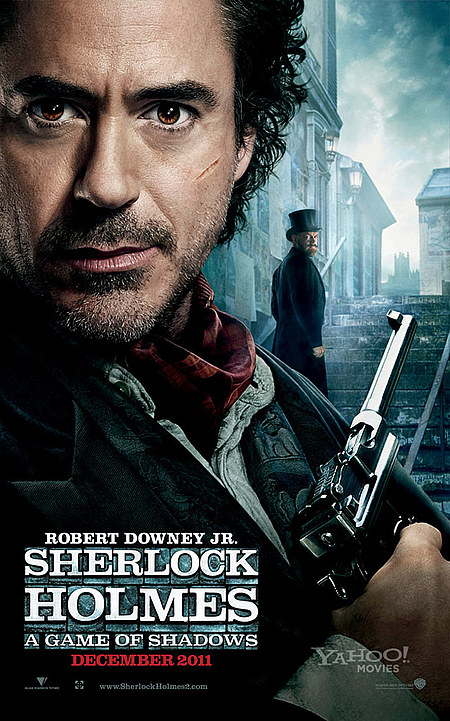
While it wasn't for everybody, I actually liked the first installment in Guy Ritchie's Sherlock Holmes series. The energy between the three lead actors--Robert Downey, Jr., Jude Law, and Rachel McAdams--was intoxicating, and their banter was engaging.
Unfortunately, nearly everything that worked in the first one is absent from Sherlock Holmes: A Game of Shadows. The witty banter is largely missing. The chemistry between Downey and McAdams is gone because she is taken out of the picture in the first ten minutes. She is replaced with the leaden Noomi Rapace, whose Roma fortune teller brings little to the tale. The dialogue between the rakish Holmes and Watson lacks the verve that was present in the first.
And despite the fact that he's finally facing off against the supervillain, Dr. James Moriarty (played effectively by Jared Harris), the action sequences, especially the one in the woods, are so obfuscated by Guy Ritchie's infatuation with that herky-jerky, computer-generated, stop-and-start editing of action set pieces as to have been rendered completely unintelligible.
If you liked the first one, this is quite a let-down. If you didn't, you'd like it even less.
It is nearly impossible to go into Sherlock Holmes without a healthy amount of trepidation given that Guy Ritchie is at the helm. Eleven years ago, he seemed to establish himself well with his great debut feature-length film, Lock, Stock, and Two Smoking Barrels. His second film, Snatch, was still a good time but was lacking in originality, as it was essentially mining the same territory with a higher budget and star-studded cast.
After that, he married Madonna, made the universally panned departure from form Swept Away, tucked his tail between his legs, went back to ripping off his own first film--only this time it was like the later Michael Keatons in Multiplicity and the virtually unreleasable Revolver and RockNRolla came out.
With the knowledge of his career path inescapably holding firm to my subconscious, I still held out hope for Sherlock Holmes to be good.
I am happy to say that my hope has been validated.
Perhaps it was that Ritchie, whose issues have never really been on the technical side of the directorial duties but rather on the storytelling side of things, has finally helmed a film that someone else wrote. The presence of other minds at work on the narrative end of things is welcome here and protects against a singularity of vision that had seemingly stagnated his growth as a filmmaker and resulted in a decade of disappointing output.
Perhaps it was that Ritchie surrounded himself with a fresh set of actors. In addition to the four collective Academy Award nominations of Jude Law and Robert Downey, Jr., the adorable firecracker Rachel McAdams graces the film with her presence. If she made ten movies a year, it still wouldn't be enough for my liking. Jude Law finally gets off the five year box office poison wave he had been riding and shows us what we had been missing out on while he went through his own career hiccup. And Downey? Well, by my count he's done at least seven solid-to-great movies in since 2005 (mostly great) and seems to be touched with quite the bit of good luck. Guy Ritchie could certainly have done worse than this cast, and I'll surely talk about this a little more as we go. Before we move further, here is the trailer to serve as a refresher:
Now, I'm just going to come out and say this: Of all of the big movies that came out last year, I'd have to say that Sherlock Holmes left me the most satisfied. It should be noted that I'm no Sherlock Holmes purist. I'm not some bizarre Holmes fanboy. I can only tell you what I liked.
Guy Ritchie has clearly surrounded himself with the right cast and crew to fully realize his vision for this film. As for that vision, he gives the audience a look at a very dirty London apparently right around the turn of the 20th Century. The London brought to the screen here is thoughtfully and meticulously conceived and spectacularly, fully realized.
From a camera work standpoint, Ritchie's signature, stop-and-start, rotationally-inclined edits are used sparingly and are not shoe-horned into sequences in which they are not appropriate. In fact, it is actually only incorporated when Holmes, who clearly processes things faster than the average fella, has slowed things down and worked out a plan of action that he is about to set off upon, so it actually fits fairly well within the context of the film. When those sequences replay in quick time, they work as well. For once, it seems as though these visual flairs are not just for show, but rather that they serve a function that is complimentary to the narrative.
As for the Holmes/Watson dynamic, there are certainly the undertones of sexual ambiguity, but the most important element of their relationship is strong. Watson is to Holmes as Wilson is to House. Here, they both happen to be badasses with an ability to fight, but unlike some of the hokier Sherlock Holmes films Watson is a man not to be trifled with.
I have heard some complain about the boxing sequence in the early goings as seeming like it was Ritchie trying to force a scene playing to his filmic wheelhouse into the film, but I beg to differ with that assertion. Throughout the film, it seems as though Holmes is seeking out adventure almost as much for the sport of it as anything else. As boxing was the sport of the time, it makes sense that the thrill-seeking Holmes would step into the ring to fight. Now, Holmes's* use of Brazilian jiu-jitsu may seem like it is potentially out of place, but barjitsu (jiu-jitsu for all intents and purposes) is apparently present in Sir Arthur Conan Doyle's The Return of Sherlock Holmes.
*Fuck AP style. I'm using apostrophe-s when a singular noun ending in the letter 's' needs to be possessive.
Back to the acting, Downey has been rock-solid pretty much since Kiss Kiss Bang Bang and has been otherworldly good in at least* three of his past four films. His turn as Sherlock Holmes fits in well amongst Tony Stark and Kirk Lazarus (which truly is amazing--I never think about how that is Downey in blackface). He perfectly embodies Holmes at his most incorrigible, brilliant, drug-addled, and inquisitive.
*I have not yet seen The Soloist. I suppose it, too, could contain a great Robert Downey, Jr., performance, but I can't say I'm insanely psyched about seeing that film.
Really, with Downey cast as the lead, it was going to take a minor disaster to have the film run off the tracks. Given Ritchie's ten-year track record, the likelihood of that minor disaster actually taking place was much, much higher. Luckily for all involved, disaster was averted. In fact, it was never even close to being disastrous. Instead, Guy Ritchie has an international hit on his hands, and Robert Downey, Jr., would seem to be the star of another lucrative film franchise.