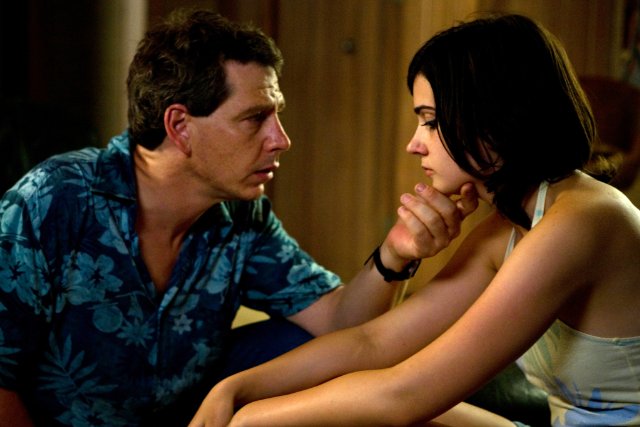
Bullhead happens in a foreign place for most of us. Set against the backdrop of agrarian Flanders and its seamy underbelly*, it follows a small-time beef farmer who--along with his also crooked cohorts--is working on closing a deal with a notorious beef trader of the sketchy and criminal variety.
*I should proffer the information that when I saw the subtitled words 'Hormone Mafia' printed across the bottom of the screen I chuckled.
This is the set-up, but it is merely a metaphorically charged world to set the story of Jacky Vanmarsenille into motion. First-time feature-length writer/director Michael R. Roskam takes the deliberate route in presenting Jacky's tale, dropping small morsel after small morsel of information about the quiet but beastly protagonist. From the get-go, a mystery is built around Jacky. Little by little that mystery is revealed. His social timidness contrasts his physicality beautifully. His similarity to the cattle he's raising is rich with subtext. There is a poignancy to his devolution into the beasts he raises, and this relationship keeps the audience rapt with curiosity.
Despite its richness in metaphor and allegory, Bullhead does come perilously close to going over the line from contemplative to slow. While hesitant to place blame whilst watching with engorged bladder, one could question whether or not a more savage cut could have been performed in the editing room. Its pacing wasn't intolerable, but a bit probably could have been trimmed.
Regardless, Bullhead, a title that at least in part has to be a bit tongue-in-cheek, is a compelling story, and its hero is an interesting one. Matthias Schoenaerts's turn as Jacky is a heavily slanted to the non-verbal, allowing his expressive face (and the resultant subconscious of the audience) to do the talking. Roskam's eye shows clearly his background in painting, and the film is strong in spite of its deliberateness.
Showing posts with label Foreign cinema. Show all posts
Tuesday, February 21, 2012
Monday, November 28, 2011
Man on Film: Inni
There is a stark contrast between the previous Sigur Rós film, Heima, and the new one, Inni. Past the obvious differences in the visual palettes of each film, Heima sets the band against the backdrop of Iceland--their home country--while Inni is more intimate, essentially being a concert film. This makes sense, as their titles translate to "home" and "inside," respectively, from Icelandic.
While Heima sets off to contextualize the band with performances all over Iceland in various locales, Inni directs its gaze on the band themselves. This serves the apparent goal of the film. Filmed almost exclusively in close shots of the members of the band, often paring its focus down to shots of just the playing of the instruments or Jónsi's face while singing, Inni definitely brings the audience close to the band. Its grainy, 16mm feel is contrived--literally, in this case, as it was actually produced by filming the original digital stock in 16mm "sometimes through prisms and other found objects" as per their website--but does produce the desired effect of drawing the audience in to the concert experience.
That concert experience is much more the band's experience than the audience's, as the audience a largely removed from the film, which is honestly preferable. Unfortunately, in setting his aim so tightly on the band, director Vincent Morriset (and possibly the band) eschews the grandeur ever-present in Sigur Rós's epic brand of post-rock. The epic scope and the geography that makes itself known in their music are not completely gone, but they are certainly diminished. Perhaps this loss is meant to be supplanted by increased emotional investment, and the interstitial archival footage set between the songs does work toward this end, but the lost element of what worked so spectacularly well in Heima (and really, what works for the band as a whole) is not completely replaced by the heightened kinship.
Having said all that, Inni is a different glimpse at the band. It succeeds in bringing the audience to the stage, enabling them to experience the show vicariously through the band. When viewing Inni in a disappointed light, one does so by comparing it to the inimitable Heima, which may be the best music documentary out there. In a vacuum (or without having seen Heima), Inni is damn fine. Its stark black-and-white palette is engrossing. The light that intermittently bleeds into the frame bends the band into and out of the black, adding an affective expressionistic flair to the film. While the band's performances aren't set against the arresting backdrop of the Icelandic countryside, the filmic presentation of these nine songs is enthralling, even at this scale.
As the film concludes, one cannot help but look forward to 2012, as Inni whets the appetite for new Sigur Rós material tentatively scheduled for a spring release. This feeling is likely the most important thing take from this experience. When it's over, you want more.
While Heima sets off to contextualize the band with performances all over Iceland in various locales, Inni directs its gaze on the band themselves. This serves the apparent goal of the film. Filmed almost exclusively in close shots of the members of the band, often paring its focus down to shots of just the playing of the instruments or Jónsi's face while singing, Inni definitely brings the audience close to the band. Its grainy, 16mm feel is contrived--literally, in this case, as it was actually produced by filming the original digital stock in 16mm "sometimes through prisms and other found objects" as per their website--but does produce the desired effect of drawing the audience in to the concert experience.
That concert experience is much more the band's experience than the audience's, as the audience a largely removed from the film, which is honestly preferable. Unfortunately, in setting his aim so tightly on the band, director Vincent Morriset (and possibly the band) eschews the grandeur ever-present in Sigur Rós's epic brand of post-rock. The epic scope and the geography that makes itself known in their music are not completely gone, but they are certainly diminished. Perhaps this loss is meant to be supplanted by increased emotional investment, and the interstitial archival footage set between the songs does work toward this end, but the lost element of what worked so spectacularly well in Heima (and really, what works for the band as a whole) is not completely replaced by the heightened kinship.
Having said all that, Inni is a different glimpse at the band. It succeeds in bringing the audience to the stage, enabling them to experience the show vicariously through the band. When viewing Inni in a disappointed light, one does so by comparing it to the inimitable Heima, which may be the best music documentary out there. In a vacuum (or without having seen Heima), Inni is damn fine. Its stark black-and-white palette is engrossing. The light that intermittently bleeds into the frame bends the band into and out of the black, adding an affective expressionistic flair to the film. While the band's performances aren't set against the arresting backdrop of the Icelandic countryside, the filmic presentation of these nine songs is enthralling, even at this scale.
As the film concludes, one cannot help but look forward to 2012, as Inni whets the appetite for new Sigur Rós material tentatively scheduled for a spring release. This feeling is likely the most important thing take from this experience. When it's over, you want more.
Wednesday, June 29, 2011
Man on Film: 13 Assassins
For the unindoctrinated, Takaski Miike is one crazy motherfucker. Anyone who has seen Visitor Q
, Ichi the Killer
, or Audition
can attest to this. Having seen these movies, the notion of Takashi Miike helming an epic samurai film certainly piques one's interest. In the abstract, piecing together what the end product might actually consist of produces an extremely bizarre and mind-blowingly violent flick. In reality, 13 Assassins
is a relatively straight-forward samurai film enriched with a strong sense of humor and a balls-to-the-wall blow-out of a final battle sequence.
Reality, for this film-goer, was a great thing.
In 13 Assassins, Takashi Miike has crafted an entirely kick-ass samurai film. He hits all the beats to stir up righteous indignation at their cause, draws up an evil and indefensible villain, and imbues his samurai with equal parts humor and honor. It is easy to root for these men on a mission, and the voyage there is enjoyable.
But the centerpiece of the film is its climax, and its climax is an orgiastic explosion of righteous kills by arrow and sword. While the hopes for insanely graphic violence are almost innate when speaking of a Takashi Miike film, this is not what one might expect if they have seen Ichi the Killer. While known for cartoonish, insanely over-the-top, and absurdly graphic violence, he reigns it in slightly. Yes, a ton of the Big Bad's henchmen meet their maker at the end of a blade, but the violence isn't like the final act of Kill Bill, Vol. 1 or anything. It's filmed in a much more traditional way, which wasn't what I personally expected from Takaski Miike, but that isn't to say it was disappointing. Really, with the exception of one ridiculous flaming livestock effect, there weren't any missteps, and he stays largely within the conventions of the genre in a good way.
In short: 13 Assassins is a helluva ride.
Reality, for this film-goer, was a great thing.
In 13 Assassins, Takashi Miike has crafted an entirely kick-ass samurai film. He hits all the beats to stir up righteous indignation at their cause, draws up an evil and indefensible villain, and imbues his samurai with equal parts humor and honor. It is easy to root for these men on a mission, and the voyage there is enjoyable.
But the centerpiece of the film is its climax, and its climax is an orgiastic explosion of righteous kills by arrow and sword. While the hopes for insanely graphic violence are almost innate when speaking of a Takashi Miike film, this is not what one might expect if they have seen Ichi the Killer. While known for cartoonish, insanely over-the-top, and absurdly graphic violence, he reigns it in slightly. Yes, a ton of the Big Bad's henchmen meet their maker at the end of a blade, but the violence isn't like the final act of Kill Bill, Vol. 1 or anything. It's filmed in a much more traditional way, which wasn't what I personally expected from Takaski Miike, but that isn't to say it was disappointing. Really, with the exception of one ridiculous flaming livestock effect, there weren't any missteps, and he stays largely within the conventions of the genre in a good way.
In short: 13 Assassins is a helluva ride.
Tuesday, April 19, 2011
Man on Film: Biutiful
If you have seen Alejandro González Iñárritu's other three feature-length directorial efforts, you likely understand what you are getting into with Biutiful. If one were to list Amores Perros
, 21 Grams
, and Babel's shared traits, it would be that they are visually arresting, often bleak, and run perhaps a little long. While I happen to like those three films, I wouldn't necessarily cite the third trait as a strength, and the second limits his films' rewatchability.
Biutiful marks the first feature that he has done since his public falling out with scribe Guillermo Arriaga, who got up on his soap box about authorship of films in the ramp-up to the Oscars when Babel was nominated for seven awards. While I happen to love Arriaga's work, both with Iñárritu* and without him, it is a little refreshing to see something different from Iñárritu himself.
*The Three Burials of Melquiades Estrada
may have been my favorite movie of the past decade.
Citing his father's life as inspiration for this film, this is clearly a very personal film for Iñárritu. More than any of his previous works, there are truly heartwrenching moments in this film. Uxbal, played to perfection by Javier Bardem, is a father of two in Barcelona living on the fringe, hustling to make a dime in morally ambiguous ways, and trying to get his affairs in order as terminal cancer is bearing down on him. As he scrambles to leave something for his two young children while their mother's grip on life loosens at every turn, your heart breaks.
The film is deeply affective, in spite of its length. Bardem alone should get you excited about watching this film, as there are not many in the acting game who are as consistently amazing as he is. Uxbal is far from perfect and isn't above exploitation to serve his own benefit, but Alejandro González Iñárritu's world in film is not one of black and white.
A quick formatting note, I updated the site to include the Amazon Associates widget. There will be links in some of the entries now. Apologies if this is a turn-off. I assure you, this will not affect what I write at all.
And don't look now, but there are already three entries written for this week, and I'm starting another.
![]() |
| On Blu-ray May 31st |
*The Three Burials of Melquiades Estrada
Citing his father's life as inspiration for this film, this is clearly a very personal film for Iñárritu. More than any of his previous works, there are truly heartwrenching moments in this film. Uxbal, played to perfection by Javier Bardem, is a father of two in Barcelona living on the fringe, hustling to make a dime in morally ambiguous ways, and trying to get his affairs in order as terminal cancer is bearing down on him. As he scrambles to leave something for his two young children while their mother's grip on life loosens at every turn, your heart breaks.
The film is deeply affective, in spite of its length. Bardem alone should get you excited about watching this film, as there are not many in the acting game who are as consistently amazing as he is. Uxbal is far from perfect and isn't above exploitation to serve his own benefit, but Alejandro González Iñárritu's world in film is not one of black and white.
A quick formatting note, I updated the site to include the Amazon Associates widget. There will be links in some of the entries now. Apologies if this is a turn-off. I assure you, this will not affect what I write at all.
And don't look now, but there are already three entries written for this week, and I'm starting another.
Monday, January 3, 2011
The Queue Continuum: The Girl with the Dragon Tattoo
As promised last time, here is the first entrant into what should be a fruitful, if often shorter, additional section to the blog. One in which we (perhaps only royally speaking) look at movies that are available on Netflix Instant Queue and therefore instantly accessible to many of you readers.
The Girl with the Dragon Tattoo is the Swedish adaptation of the absurdly (and arguably unjustly) popular Swedish crime novel by Stieg Larsson. Having just finished the book, I decided to throw this on in the midst of a Netflix-athon with Munch My Benson co-contributor, softitems. Given the freshness of the material, I oddly found myself feeling obligated to explain things, and this was not because of any shortcomings on her part.
Honestly, the film seemed to be a bit of a mess to me. Since the book shared a similar shortcoming, I suppose it only makes sense in the end, but it just felt like there were plot holes. This is largely because the book is an unwieldy material to have to adapt. There are essentially 150 pages before the disappearance of Harriet Vanger is touched on and another 100 after that aspect of the story is resolved. These 250 pages deal largely with the mostly disposable Wennerstrom Affair, but there is also crucial character development of the male protagonist that occurs therein. As this section is largely omitted from the movie, the development of Mikael Blomkvist is sorely lacking. Without this, the fact that Lisbeth (the female protagonist) is drawn to Mikael kind of comes out of the blue.
Given that they are screenwriters Nikolaj Arcel and Rasmus Heisterberg were tasked to adapt a 600 page book, they probably did about as well as could be expected. There is a lot of fat in the novel, and for the most part they trimmed it well. A few characters were combined and the mystery was streamlined a bit. I don't know that I would say the film wasn't worth watching, but I honestly have to say, given its shortcomings, that I am actually curious to see the impending American remake, and you couldn't have said that about most of the American takes on the Scandinavian oeuvre. Given that Steven Zaillian is adapting the screenplay, and David Fincher is directing, I can't imagine it won't be an improvement.
The other thing that struck me while watching the film was, "Wait, I don't remember the Scandinavian peoples as being particularly homely..." Yet, here, frankly, not an attractive cast. Pretty much across the board. Call me shallow, but it made me feel like I was watching a mid-90s BBC production.
Maybe I'm in the minority here, but I just did not get why the book and now the movie are all the rage. They're both all right. The book is readable. The movie is watchable. They are both entertaining enough, but they both seem flawed, and the thing that redeemed the book for me--the interesting relationship between Mikael and Lisbeth--is kind of handled poorly in the Niels Arden Oplev film version.
But it is out there for you to watch. Did anyone out there feel strongly differently?
(Man, some of that subtitle spelling is bad...)
The Girl with the Dragon Tattoo is the Swedish adaptation of the absurdly (and arguably unjustly) popular Swedish crime novel by Stieg Larsson. Having just finished the book, I decided to throw this on in the midst of a Netflix-athon with Munch My Benson co-contributor, softitems. Given the freshness of the material, I oddly found myself feeling obligated to explain things, and this was not because of any shortcomings on her part.
Honestly, the film seemed to be a bit of a mess to me. Since the book shared a similar shortcoming, I suppose it only makes sense in the end, but it just felt like there were plot holes. This is largely because the book is an unwieldy material to have to adapt. There are essentially 150 pages before the disappearance of Harriet Vanger is touched on and another 100 after that aspect of the story is resolved. These 250 pages deal largely with the mostly disposable Wennerstrom Affair, but there is also crucial character development of the male protagonist that occurs therein. As this section is largely omitted from the movie, the development of Mikael Blomkvist is sorely lacking. Without this, the fact that Lisbeth (the female protagonist) is drawn to Mikael kind of comes out of the blue.
Given that they are screenwriters Nikolaj Arcel and Rasmus Heisterberg were tasked to adapt a 600 page book, they probably did about as well as could be expected. There is a lot of fat in the novel, and for the most part they trimmed it well. A few characters were combined and the mystery was streamlined a bit. I don't know that I would say the film wasn't worth watching, but I honestly have to say, given its shortcomings, that I am actually curious to see the impending American remake, and you couldn't have said that about most of the American takes on the Scandinavian oeuvre. Given that Steven Zaillian is adapting the screenplay, and David Fincher is directing, I can't imagine it won't be an improvement.
The other thing that struck me while watching the film was, "Wait, I don't remember the Scandinavian peoples as being particularly homely..." Yet, here, frankly, not an attractive cast. Pretty much across the board. Call me shallow, but it made me feel like I was watching a mid-90s BBC production.
Maybe I'm in the minority here, but I just did not get why the book and now the movie are all the rage. They're both all right. The book is readable. The movie is watchable. They are both entertaining enough, but they both seem flawed, and the thing that redeemed the book for me--the interesting relationship between Mikael and Lisbeth--is kind of handled poorly in the Niels Arden Oplev film version.
But it is out there for you to watch. Did anyone out there feel strongly differently?
(Man, some of that subtitle spelling is bad...)
Monday, December 27, 2010
Man on Film: Rare Exports
If you like old Finnish cock, you'll love Rare Exports. If your idea of fun isn't extras from the Lemon Party being thrown into the Finnish tundra nude for 20 minutes, then maybe it would be best for you to avoid Rare Exports.It was weird in a few ways. Namely, it wasn't really the ludicrous Santa horror movie I was expecting it to be based on the trailer.
It was, however, the movie with the most old cock I can fathom. That's a lot of old cock. And it had it. Holy hell, did it have loads of old, old, old dick. Other than that, all of the action seemed to be in the trailer.
It was a weird little Scandinavian film, with bearded old Finnish dudes naked in the wintry out-of-doors and a kid with a shitty mullet and some other stuff that happened.
I don't know.
I think I fell asleep.
Tuesday, December 14, 2010
Man on Film: Norwegian Wood is Coming! Norwegian Wood is Coming!
All right, so this is sort of filler*, but it's something I'm excited about nonetheless.
*I am working on some other stuff (write-up of a Grace Kelly bio and a Henning Mankell book, for starters), and hot stove has reinvigorated Royalscentricity a bit. Don't worry, the actual start of baseball season will surely kill off any energy I have for the Royals...
Haruki Murakami's novel Norwegian Wood has been adapted by Vietnamese-French director Tran Anh Hung. While reviews have been lukewarm--anything less would be surprising given the reverence of the source material--it is apparently blessed with stunning cinematography.
Perhaps more importantly, the beautiful Rinko Kikuchi plays Naoko, and her performance has been lauded. Known to most of us for her turns in Babel and The Brothers Bloom, Naoko provides her with a rich character to embody, serving as a long overdue follow-up to her Oscar-nominated turn as Chieko Wataya in Babel.
As if Rinko Kikuchi were not enough, Jonny Greenwood has apparently composed the score. Given his phenomenal score for There Will Be Blood, I am curious as to what he has done for this one.
I am kind of excited, as Murakami is one of my favorite authors, and the book was great.
The trailer that follows is not the highest quality that I could find, but it did have subtitles.
The release date in the US has to be announced, but the UK date is March 18th. Hopefully the US date is right around then, too.
*I am working on some other stuff (write-up of a Grace Kelly bio and a Henning Mankell book, for starters), and hot stove has reinvigorated Royalscentricity a bit. Don't worry, the actual start of baseball season will surely kill off any energy I have for the Royals...
Haruki Murakami's novel Norwegian Wood has been adapted by Vietnamese-French director Tran Anh Hung. While reviews have been lukewarm--anything less would be surprising given the reverence of the source material--it is apparently blessed with stunning cinematography.
Perhaps more importantly, the beautiful Rinko Kikuchi plays Naoko, and her performance has been lauded. Known to most of us for her turns in Babel and The Brothers Bloom, Naoko provides her with a rich character to embody, serving as a long overdue follow-up to her Oscar-nominated turn as Chieko Wataya in Babel.
As if Rinko Kikuchi were not enough, Jonny Greenwood has apparently composed the score. Given his phenomenal score for There Will Be Blood, I am curious as to what he has done for this one.
I am kind of excited, as Murakami is one of my favorite authors, and the book was great.
The trailer that follows is not the highest quality that I could find, but it did have subtitles.
The release date in the US has to be announced, but the UK date is March 18th. Hopefully the US date is right around then, too.
Tuesday, October 26, 2010
Man on Film: Animal Kingdom
Under the misguided idea that this was a contemporary Australo-Western, I went into a "Katy's pick" not really expecting the film that I was about to see. What Animal Kingdom ended up being was a dark as hell crime drama centered around a boy being re-introduced to the extended family that his deceased mother had tried to keep him away from.
While I am somewhat hesitant to liken films to other films within this space, this film does feel akin to City of God, with its young protagonist thrown into a world rife with violence. Animal Kingdom is much smaller in scope than the Fernando Meirelles masterpiece, and J, Animal Kingdom's hero, is much less charismatic and endearing than his City of God counterpart, Buscapé.
The real strength of the film is in the supporting cast. James Frecheville, the young lead, is (presumably/hopefully) called upon to play a character essentially in a daze. As the film kicks off, his addict mother has overdosed, and he heads back to her family, a family of criminals. It is those criminals who make the film compelling.
Joel Edgerton* stands out in his relatively brief time on screen as the immensely likable Baz. It's is his character's presence that the entire film essentially hinges upon. Without his charm, the Cody family (Baz is the eldest son Pope's best friend and partner) is not one that can be empathized with. While they are criminals, Baz, their leader, is such a strong presence that it is easy to root for the crew from the start.
*Recognizable to many (for better or worse) as Owen Lars from the abysmal Star Wars prequels.
This is important because once that element is missing, the rest of the family begins to unravel, and it's not pretty. Once the shit hits the fan and the paranoia reaches a fever pitch, the brothers Cody begin to self-destruct fantastically. J's coke-fueled drug-dealing uncle, Craig, implodes before our eyes, and Sullivan Stapleton does his best to channel Ray Liotta when making this turn.
The performance that really makes the film though is that of Ben Mendelsohn as Pope. Pope's presence is an unnerving one. A sociopath at his core, the danger Pope poses to everyone around him lingers in the air, tension building uncomfortably, released intermittently and randomly through outbursts only to build right back up again almost instantaneously. Pope's desire to fit in with and ultimately be depended upon by his family and friends at first seems slightly pathetic but slowly this effort on his part shows evidence of his attempting to be a human--something he is in form only. The chaotic energy he brings to the film is frightening, and Mendelsohn brings unhinged to a seldom-seen cinematic level.
I would also be remiss if I made no mention of the performance of Jacki Weaver. The family had to get fucked up somehow, and it was her turn as the enabling mother who always wants to be in the middle of her boys' schemes and misdeeds. Her willingness to do anything for her boys, no matter the moral implications, is ultimately what sets the stage for their demise. As the movie progresses, her moral ambiguity gives way to a complete and utter amoral core, where she is willing to do anything to anyone to protect her sons, even if it means fucking her own grandson over.
As Guy Pearce's Detective Leckie tries to protect J, he ends up throwing him to the wolves that are his family. That is where Animal Kingdom sets itself apart from the standard crime drama fare. By the time, the end of the film rolls around the cub, J, either has to eat or be eaten.
Whether or not that particular element is intrinsically Australian (I'll refrain from stepping into the realm of cultural stereotyping, fun as I may find it to be), the film seems to be imbued with the lawlessness that we Americans tend to place upon the wild continent of Australia. There is a sparse, contemplative nature to the film that boldly compliments the narrative, a self-assured decision from the first-time feature-length writer/director David Michôd. This is an impressive debut to be sure, and it leaves me looking forward to an Australian film that doesn't even exist--Michôd's follow-up to Animal Kingdom.
Oh, and I totally forgot how hot Laura Wheelwright was in this movie until I rewatched the trailer.
Katy would have been upset if I hadn't mentioned this.
While I am somewhat hesitant to liken films to other films within this space, this film does feel akin to City of God, with its young protagonist thrown into a world rife with violence. Animal Kingdom is much smaller in scope than the Fernando Meirelles masterpiece, and J, Animal Kingdom's hero, is much less charismatic and endearing than his City of God counterpart, Buscapé.
The real strength of the film is in the supporting cast. James Frecheville, the young lead, is (presumably/hopefully) called upon to play a character essentially in a daze. As the film kicks off, his addict mother has overdosed, and he heads back to her family, a family of criminals. It is those criminals who make the film compelling.
Joel Edgerton* stands out in his relatively brief time on screen as the immensely likable Baz. It's is his character's presence that the entire film essentially hinges upon. Without his charm, the Cody family (Baz is the eldest son Pope's best friend and partner) is not one that can be empathized with. While they are criminals, Baz, their leader, is such a strong presence that it is easy to root for the crew from the start.
*Recognizable to many (for better or worse) as Owen Lars from the abysmal Star Wars prequels.
This is important because once that element is missing, the rest of the family begins to unravel, and it's not pretty. Once the shit hits the fan and the paranoia reaches a fever pitch, the brothers Cody begin to self-destruct fantastically. J's coke-fueled drug-dealing uncle, Craig, implodes before our eyes, and Sullivan Stapleton does his best to channel Ray Liotta when making this turn.
The performance that really makes the film though is that of Ben Mendelsohn as Pope. Pope's presence is an unnerving one. A sociopath at his core, the danger Pope poses to everyone around him lingers in the air, tension building uncomfortably, released intermittently and randomly through outbursts only to build right back up again almost instantaneously. Pope's desire to fit in with and ultimately be depended upon by his family and friends at first seems slightly pathetic but slowly this effort on his part shows evidence of his attempting to be a human--something he is in form only. The chaotic energy he brings to the film is frightening, and Mendelsohn brings unhinged to a seldom-seen cinematic level.
I would also be remiss if I made no mention of the performance of Jacki Weaver. The family had to get fucked up somehow, and it was her turn as the enabling mother who always wants to be in the middle of her boys' schemes and misdeeds. Her willingness to do anything for her boys, no matter the moral implications, is ultimately what sets the stage for their demise. As the movie progresses, her moral ambiguity gives way to a complete and utter amoral core, where she is willing to do anything to anyone to protect her sons, even if it means fucking her own grandson over.
As Guy Pearce's Detective Leckie tries to protect J, he ends up throwing him to the wolves that are his family. That is where Animal Kingdom sets itself apart from the standard crime drama fare. By the time, the end of the film rolls around the cub, J, either has to eat or be eaten.
Whether or not that particular element is intrinsically Australian (I'll refrain from stepping into the realm of cultural stereotyping, fun as I may find it to be), the film seems to be imbued with the lawlessness that we Americans tend to place upon the wild continent of Australia. There is a sparse, contemplative nature to the film that boldly compliments the narrative, a self-assured decision from the first-time feature-length writer/director David Michôd. This is an impressive debut to be sure, and it leaves me looking forward to an Australian film that doesn't even exist--Michôd's follow-up to Animal Kingdom.
Oh, and I totally forgot how hot Laura Wheelwright was in this movie until I rewatched the trailer.
![]() |
| Ben Mendelsohn and Laura Wheelwright in Animal Kingdom |
Thursday, May 13, 2010
Man on Film: Un Prophete (A Prophet)
For whatever reason, I've not been making it to a lot of foreign fare in recent years. There was a time when TSLF and I would see about 50% foreign and 50% domestic films. That isn't the case anymore.
Well, I took in A Prophet a few weeks back with Chad and Steve (my only friend in Austin who is also a Super Furry Animals fan), and I was floored. I knew very little about the film other than the fact that it was a French prison movie. Having seen a fair share of French films, I expected some cursing cheese-eating surrender monkeys munching on baguettes, wearing berets, and occasionally raping each other whilst smoking cigarettes. What I got was an exceptional movie-going experience.
This being the first Jacques Audiard film I've seen, I came into the film not knowing what I was about to be given. This is easily the best prison movie since The Shawshank Redemption, which I loved. The film chronicles the rise of an Algerian prisoner through the inmate power structure of a French prison. The closest parallel to his story I can think of is that of Don Corleone story in The Godfather, Part II. This comparison is apropos in both the narrative and the qualitative sense, as A Prophet really does deserve to be mentioned in the same sentence as the best of The Godfather films.
Malik el Djebena as played by Tahar Rahim* is essentially a slightly more passive young Don Corleone if he had the ability to assimilate himself into nearly any group. Malik's prison ascension is compelling, and as the Arab having to be a lap dog to the Corsicans for much of the movie, it is hard not to root for him.
*It's weird but Rahim reminds me a lot of Maurice Compte, who I've always recognized as the guy from The Dream Catcher--not the shitty Stephen King adaptation--a film I recall having liked. Unfortunately, no one else in the world other than Compte himself would remember him. He was one of Gunn's peeps when Gunn was introduced on "Angel."
Generally speaking, the acting seems solid. I use the word 'seems' here because I hesitate to trust myself when evaluating the acting in a foreign-language film. Regardless, nothing seems to be amiss on the acting front.
Now I should note that the pacing of the narrative is very European. It takes its sweet time in getting rolling, but once Malik endears himself to the Corsicans, the film finally gets its legs under it. The slow start works in this case, and his efforts to embed himself in the backyard of the Corsicans and the ensuing double-/triple-agent life he takes on is fascinating.
All in all, the film is great, and it still seems to be playing in art-house theaters. Go see it. You'll be so happy you did.
Well, I took in A Prophet a few weeks back with Chad and Steve (my only friend in Austin who is also a Super Furry Animals fan), and I was floored. I knew very little about the film other than the fact that it was a French prison movie. Having seen a fair share of French films, I expected some cursing cheese-eating surrender monkeys munching on baguettes, wearing berets, and occasionally raping each other whilst smoking cigarettes. What I got was an exceptional movie-going experience.
This being the first Jacques Audiard film I've seen, I came into the film not knowing what I was about to be given. This is easily the best prison movie since The Shawshank Redemption, which I loved. The film chronicles the rise of an Algerian prisoner through the inmate power structure of a French prison. The closest parallel to his story I can think of is that of Don Corleone story in The Godfather, Part II. This comparison is apropos in both the narrative and the qualitative sense, as A Prophet really does deserve to be mentioned in the same sentence as the best of The Godfather films.Malik el Djebena as played by Tahar Rahim* is essentially a slightly more passive young Don Corleone if he had the ability to assimilate himself into nearly any group. Malik's prison ascension is compelling, and as the Arab having to be a lap dog to the Corsicans for much of the movie, it is hard not to root for him.
*It's weird but Rahim reminds me a lot of Maurice Compte, who I've always recognized as the guy from The Dream Catcher--not the shitty Stephen King adaptation--a film I recall having liked. Unfortunately, no one else in the world other than Compte himself would remember him. He was one of Gunn's peeps when Gunn was introduced on "Angel."
Generally speaking, the acting seems solid. I use the word 'seems' here because I hesitate to trust myself when evaluating the acting in a foreign-language film. Regardless, nothing seems to be amiss on the acting front.
Now I should note that the pacing of the narrative is very European. It takes its sweet time in getting rolling, but once Malik endears himself to the Corsicans, the film finally gets its legs under it. The slow start works in this case, and his efforts to embed himself in the backyard of the Corsicans and the ensuing double-/triple-agent life he takes on is fascinating.
All in all, the film is great, and it still seems to be playing in art-house theaters. Go see it. You'll be so happy you did.
Sunday, August 23, 2009
Man On Film: Ketchup
I know, it's been a while. I've been busy.
That doesn't mean I've not been going to movies.
Rather, I've been unable to write about them.
What is to follow could be a bit lengthy. Sure, I could split these up, but this backlog has been piling up. Some of these may receive more time than others for varying reasons but not always related to my like/dislike of the film. Given the ground I'll be trying to cover here, these individual write-ups will surely be lacking, especially in relation to, say, what I did when I wrote about The Dark Knight in two tomes last year.
Here goes:
Brüno
Pretty damn funny. Unlike Borat, it didn't feel like 85% of the movie was recycled bits from "Da Ali G Show". The urethral "Brüno" shout in his pilot was truly shocking.
I am curious as to what Sacha Baron Cohen is going to do now that his three characters have been given the full-length feature treatment.
Funny People
I had a film professor who specialized in screenwriting. He had written F/X but did not end up being the credited screenwriter. In the sci-fi class I took from him, his analysis was limited to breaking down this film into its three-act structure while giving a cursory look at other narrative elements. His hard-on for the three-act structure ruled his life.
While that seemed a little ridiculous during the class, Judd Apatow's latest seems like it could have more closely adhered to the pacing inherent in that Aristotelian construct.
Now I should say that I didn't have any major issues with the film. Of Apatow's three directorial efforts, Funny People is probably his most complete film. It is certainly his most adult. That doesn't mean it is the most enjoyable. It probably has the least re-watch value of the three. Sandler gives his best performance since Punch-Drunk Love. Jonah Hill manages to avoid being irritating, an issue I had upon repeat viewings of Superbad. Rogen is fine as well. The problem when it comes to re-watching is that the two male lead characters are largely unlikeable.
Oh, and there's the fact that despite being entirely watchable, the pacing leaves a bit to be desired.
But, again, the film is good. The stand-up is really damn funny. The interplay between the roommates is great. Schwartzmann is his best in ages (although it all looks to be topped by "Bored to Death"). The horribleness of the show-within-the-movie is hilarious as well. Aside from the pacing issues, the film doesn't have a lot of weaknesses.
(500) Days of Summer
I actually thought I had written about this one and was surprised to find out that I hadn't.
I tend to like the film work of Joseph Gordon-Levitt. Zooey Deschanel wasn't exactly stretching her wings and flying to new territory in terms of playing a new role. That being said, she does it fairly well. The music talk in the film was a little grating, but at the same time the characters in the film were supposed to be my peers, and that is sadly most of what we talk about. The one point I will make is that it seems like a leap to state that someone has good taste in music based on the one song you overhear them listening to. For all she knew in the elevator, he listened to Nickleback, Mariah Carey, and Liberace and that was the one song by The Smiths on his iPod (We are assuming that he wasn't listening to a CD, right? Does anyone (other than me)?).
I did like this movie, though. It was funny, sad, and not necessarily typical of the rom-com genre. Its soundtrack, while littered with tracks by indie darlings like Feist, Regina Spektor, Wolfmother, and Spoon, is entirely appropriate for the demographic that the film is about.
Thirst
The newest Chan-Wook Park movie was pretty solid. It didn't approach the meteoric heights that Oldboy reached, but it was good. It was, however, cursed by what seemed like a ending about 45 minutes before the actual ending.
Harry Potter and the (Whatever Thing is in the Title)
The sixth movie in the series had virtually nothing happen. It's not like it sucked (but holy shit did the first two in the series), but from what the special lady friend says the next movie cannot really have much of anything happen, so that means we're getting like six hours of nothing leading up to what might be a cool conclusion.
I cannot believe that this series has even gotten this good after those abysmal first two movies. We all have Alfonso Cuaron to thank for that. His direction steered this enterprise in the right direction.
The Hurt Locker
So I fell asleep for about 20 minutes at the beginning of this film. As the second-to-last trailer was concluding, I thought to myself, "Fuck. I am tired."
That being said, what I saw was great. Jeremy Renner, who was the star of the underwhelming Dahmer, was phenomenal. The tension was great throughout. I wanted to say more and intended to see it again before doing so. I have not had the chance. This will have to do.
As I'm sure Weibel is glad to hear, The Hurt Locker put me in the hurt locker.
That doesn't mean I've not been going to movies.
Rather, I've been unable to write about them.
What is to follow could be a bit lengthy. Sure, I could split these up, but this backlog has been piling up. Some of these may receive more time than others for varying reasons but not always related to my like/dislike of the film. Given the ground I'll be trying to cover here, these individual write-ups will surely be lacking, especially in relation to, say, what I did when I wrote about The Dark Knight in two tomes last year.
Here goes:
Brüno
Pretty damn funny. Unlike Borat, it didn't feel like 85% of the movie was recycled bits from "Da Ali G Show". The urethral "Brüno" shout in his pilot was truly shocking.
I am curious as to what Sacha Baron Cohen is going to do now that his three characters have been given the full-length feature treatment.
Funny People
I had a film professor who specialized in screenwriting. He had written F/X but did not end up being the credited screenwriter. In the sci-fi class I took from him, his analysis was limited to breaking down this film into its three-act structure while giving a cursory look at other narrative elements. His hard-on for the three-act structure ruled his life.
While that seemed a little ridiculous during the class, Judd Apatow's latest seems like it could have more closely adhered to the pacing inherent in that Aristotelian construct.
Now I should say that I didn't have any major issues with the film. Of Apatow's three directorial efforts, Funny People is probably his most complete film. It is certainly his most adult. That doesn't mean it is the most enjoyable. It probably has the least re-watch value of the three. Sandler gives his best performance since Punch-Drunk Love. Jonah Hill manages to avoid being irritating, an issue I had upon repeat viewings of Superbad. Rogen is fine as well. The problem when it comes to re-watching is that the two male lead characters are largely unlikeable.
Oh, and there's the fact that despite being entirely watchable, the pacing leaves a bit to be desired.
But, again, the film is good. The stand-up is really damn funny. The interplay between the roommates is great. Schwartzmann is his best in ages (although it all looks to be topped by "Bored to Death"). The horribleness of the show-within-the-movie is hilarious as well. Aside from the pacing issues, the film doesn't have a lot of weaknesses.
(500) Days of Summer
I actually thought I had written about this one and was surprised to find out that I hadn't.
I tend to like the film work of Joseph Gordon-Levitt. Zooey Deschanel wasn't exactly stretching her wings and flying to new territory in terms of playing a new role. That being said, she does it fairly well. The music talk in the film was a little grating, but at the same time the characters in the film were supposed to be my peers, and that is sadly most of what we talk about. The one point I will make is that it seems like a leap to state that someone has good taste in music based on the one song you overhear them listening to. For all she knew in the elevator, he listened to Nickleback, Mariah Carey, and Liberace and that was the one song by The Smiths on his iPod (We are assuming that he wasn't listening to a CD, right? Does anyone (other than me)?).
I did like this movie, though. It was funny, sad, and not necessarily typical of the rom-com genre. Its soundtrack, while littered with tracks by indie darlings like Feist, Regina Spektor, Wolfmother, and Spoon, is entirely appropriate for the demographic that the film is about.
Thirst
The newest Chan-Wook Park movie was pretty solid. It didn't approach the meteoric heights that Oldboy reached, but it was good. It was, however, cursed by what seemed like a ending about 45 minutes before the actual ending.
Harry Potter and the (Whatever Thing is in the Title)
The sixth movie in the series had virtually nothing happen. It's not like it sucked (but holy shit did the first two in the series), but from what the special lady friend says the next movie cannot really have much of anything happen, so that means we're getting like six hours of nothing leading up to what might be a cool conclusion.
I cannot believe that this series has even gotten this good after those abysmal first two movies. We all have Alfonso Cuaron to thank for that. His direction steered this enterprise in the right direction.
The Hurt Locker
So I fell asleep for about 20 minutes at the beginning of this film. As the second-to-last trailer was concluding, I thought to myself, "Fuck. I am tired."
That being said, what I saw was great. Jeremy Renner, who was the star of the underwhelming Dahmer, was phenomenal. The tension was great throughout. I wanted to say more and intended to see it again before doing so. I have not had the chance. This will have to do.
As I'm sure Weibel is glad to hear, The Hurt Locker put me in the hurt locker.
Thursday, March 5, 2009
Man on Film: Waltz with Bashir
This will be a very brief reflection on the film. I'd like to write more but am spread quite thin this week. In the interest of keeping the momentum of my blogs going, I write this short entrant into the ongoing filmic series Man on Film. You can feel free to picture me as Damon Wayans while you read this...
Waltz with Bashir was visually compelling and stimulating. The animation was so engrossing that numerous times throughout the film it would occur to me that I had completely neglected to read the dialogue for at least the 30 seconds before the realization.
The film is an Israeli soldier's recounting of his quest to recover his memories of the first Lebanon War and the atrocities of the massacres in West Beirut. Told via animation, it is still the animation of the writer/director/star so it is still a quasi-documentary--an odd combination to be sure. The animation is great. The quest to recover the lost memories is for the most part interesting, especially as the puzzle of what actually happened in the war comes into picture more clearly.
Perhaps the aspect of the film that stands out the most is the Max Richter score which at times propels the film forward with its own momentum. His work with Ari Forman on this film certainly piques my interest insofar as Richter's solo work is concerned.
Even if the music for the film borders on scene-stealing, the film is still moving. If you are not moved to revulsion as the archived news footage is introduced at the film's conclusion, you are without a soul. In that moment, the film succeeds in levelling the audience with deft ferocity.
Here is the trailer:
Waltz with Bashir was visually compelling and stimulating. The animation was so engrossing that numerous times throughout the film it would occur to me that I had completely neglected to read the dialogue for at least the 30 seconds before the realization.
The film is an Israeli soldier's recounting of his quest to recover his memories of the first Lebanon War and the atrocities of the massacres in West Beirut. Told via animation, it is still the animation of the writer/director/star so it is still a quasi-documentary--an odd combination to be sure. The animation is great. The quest to recover the lost memories is for the most part interesting, especially as the puzzle of what actually happened in the war comes into picture more clearly.
Perhaps the aspect of the film that stands out the most is the Max Richter score which at times propels the film forward with its own momentum. His work with Ari Forman on this film certainly piques my interest insofar as Richter's solo work is concerned.
Even if the music for the film borders on scene-stealing, the film is still moving. If you are not moved to revulsion as the archived news footage is introduced at the film's conclusion, you are without a soul. In that moment, the film succeeds in levelling the audience with deft ferocity.
Here is the trailer:
Tuesday, December 16, 2008
Man on Film: Let the Right One In and Role Models
What follows are two untimely, brief reflections on two films that I saw a few weeks ago. Obviously, these films are not exactly fresh in my mind anymore. I probably could have written this stuff up when I was typing up that entirely masturbatory Kuffs entry last week, but I didn't. Maybe Kuffs just needed the more immediate attention. Regardless, here it goes.
************************************************************************
Let the Right One In (or Låt den rätte komma in in Swedish) is first and foremost the best pre-teen vampire movie you will ever see. Its source material was an international bestseller by the same name that was adapted for the screen by the novelist himself, John Ajvide Lindqvist. The story is simple enough: Oskar is a 12-year old brutally bullied outcast who befriends and becomes enamored with a mysterious girl, Eli, who has just moved in next door with her abiding fatherly guardian. Upon their arrival, people start disappearing while a sweet and innocent love blossoms between Oskar and Eli.
Directed by Tomas Alfredson, Let the Right One In deftly balances subtlety and nuance with a generous smattering of suspense while ultimately telling a cute story of love and devotion. The film is very Scandinavian in humor and pacing to go with its wintry climes, and it makes the inspired choice to have many of the onscreen horrors committed by humans, further endearing Eli to the audience.
If you get the chance, it's a great little film that should be seen before the American remake (oh, don't worry, it's already been greenlit--much to Alfredson's chagrin--and is to be helmed by Matt Reeves, the director of Cloverfield) surely tarnishes its name.
If that didn't convince you, maybe the trailer will help:
If you have already seen it, here's a little interview with the director, his diplomatic response to the remake is much more subdued than his initial response at moviezine.se later reported here.
************************************************************************
On an entirely different note, after three attempts I finally got to see Role Models, the latest directorial effort from David Wain of "The State" and "Stella" notoriety who previously directed the superb Wet Hot American Summer and the uneven but occasionally funny The Ten. I'd imagine just about everybody who comes here with any degree of frequency is already well aware of the film, so I'll pare my thoughts down to a reaction more than anything else.
The film was pretty funny. It came highly recommended by two readers here, and their enthusiastic reactions were probably responsible for my lofty expectations, which were not met. The kids didn't bother me, somewhat surprisingly since most kids in comedies tend to come off as too broad and/or precocious in the Cop and a Half/Problem Child/Atonement way--which are not good things if you are an adult. Seann William Scott and Paul Rudd were both funny enough, as were many of the supporting cast. There were diatribes on bullshit Starbucks-inspired coffee sizing and running jokes involving bagel dogs, both of which are topics that are near and dear to my heart. Jane Lynch always surprises me at just how funny she is in that awkward alpha-female role. I think the movie is legitimately funny. It just fell shy of my surely unreasonable expectations--which is pretty much the reason I did not ever bring myself to write an entry on Burn After Reading.
************************************************************************
Let the Right One In (or Låt den rätte komma in in Swedish) is first and foremost the best pre-teen vampire movie you will ever see. Its source material was an international bestseller by the same name that was adapted for the screen by the novelist himself, John Ajvide Lindqvist. The story is simple enough: Oskar is a 12-year old brutally bullied outcast who befriends and becomes enamored with a mysterious girl, Eli, who has just moved in next door with her abiding fatherly guardian. Upon their arrival, people start disappearing while a sweet and innocent love blossoms between Oskar and Eli.
Directed by Tomas Alfredson, Let the Right One In deftly balances subtlety and nuance with a generous smattering of suspense while ultimately telling a cute story of love and devotion. The film is very Scandinavian in humor and pacing to go with its wintry climes, and it makes the inspired choice to have many of the onscreen horrors committed by humans, further endearing Eli to the audience.
If you get the chance, it's a great little film that should be seen before the American remake (oh, don't worry, it's already been greenlit--much to Alfredson's chagrin--and is to be helmed by Matt Reeves, the director of Cloverfield) surely tarnishes its name.
If that didn't convince you, maybe the trailer will help:
If you have already seen it, here's a little interview with the director, his diplomatic response to the remake is much more subdued than his initial response at moviezine.se later reported here.
************************************************************************
On an entirely different note, after three attempts I finally got to see Role Models, the latest directorial effort from David Wain of "The State" and "Stella" notoriety who previously directed the superb Wet Hot American Summer and the uneven but occasionally funny The Ten. I'd imagine just about everybody who comes here with any degree of frequency is already well aware of the film, so I'll pare my thoughts down to a reaction more than anything else.
The film was pretty funny. It came highly recommended by two readers here, and their enthusiastic reactions were probably responsible for my lofty expectations, which were not met. The kids didn't bother me, somewhat surprisingly since most kids in comedies tend to come off as too broad and/or precocious in the Cop and a Half/Problem Child/Atonement way--which are not good things if you are an adult. Seann William Scott and Paul Rudd were both funny enough, as were many of the supporting cast. There were diatribes on bullshit Starbucks-inspired coffee sizing and running jokes involving bagel dogs, both of which are topics that are near and dear to my heart. Jane Lynch always surprises me at just how funny she is in that awkward alpha-female role. I think the movie is legitimately funny. It just fell shy of my surely unreasonable expectations--which is pretty much the reason I did not ever bring myself to write an entry on Burn After Reading.
Subscribe to:
Posts (Atom)