Thursday, March 24, 2011

Reading Rainbow: The Sportswriter by Richard Ford

Full disclosure: I finished this book two months ago. I'm not sure why it has taken me this long to get around to this post, but it has. Do not take the fact that it has taken me roughly 10 weeks to get around to this as a reflection of how I felt about the book in any way.

In short, I loved this book. This was my first venture into the writings of Richard Ford, Pulitzer Prize-winning author of Independence Day (the sequel to The Sportswriter). He had come pretty highly recommended from a few friends whose literary tastes I trust. Their recommendations are going to be more highly regarded going forward.

The novel follows Frank Bascombe, a writer who has abandoned being a novelist for writing about sports, a subject he is largely indifferent to. It is set against Easter weekend, the weekend marking the anniversary of his son's death at the age of nine and the point at which his life was thrown into a tailspin. Frank is essentially detached in every way imaginable. He even seems to be detached from himself. As he visits his son's grave, heads to Michigan with his girlfriend on a work-related weekend getaway, returns to nondescript suburban New Jersey to have an unhinged friend drop in on him, and his relationship with Vicki disintegrates at a family dinner, Frank Bascombe wanders dreamily through these episodes. Luckily, Ford toes a line that keeps Frank from erring into a territory in which he could come across as irritating or frustrating.

To say that I simply loved this book would be doing a disservice to how I really felt. While reading, I became engulfed in the book. His style floored me. I continuously marveled at his ingenuity in turning a phrase, in the unpredictable ways that his sentences would twist and turn. There seems to be nothing tethering him to the standard usage patterns of the English language. Reading his prose was, quite simply, awe-inspiring. For me to actually want to sit back, take some time, and savor the style of a writer is rare, yet that is precisely what I found myself doing while reading The Sportswriter.

To put it another way, I was so taken by The Sportswriter that I went out and bought four other Ford books as soon as I finished it.

But you don't have to take my word for it...

Wednesday, March 23, 2011

The Queue Continuum: The Cove

If you want to get angry about dolphins, this is your movie.

Seriously though, it's pretty damn good. The footage that they get of the dolphin slaughter is pretty damn shocking, and the work they go to to film it is impressive. Unfortunately, it seems like this film will never see the light of day in Japan. Despite its success in elucidating the horrors being perpetrated against these dolphins, it just doesn't seem like it is likely to affect change.

Regardless, the film works on every level other than the fact that it isn't likely to produce the desired effect in Taiji, and this is coming from someone who doesn't really give a shit about animals.

But you don't have to take--shit, wrong column.

Thursday, March 17, 2011

Man on Film: The King's Speech

Well, it's been well over a month since I saw this one. I guess I've been sidetracked.

I'll keep this relatively short (at least for me). At this point, I'd imagine almost all of the readers here at Inconsiderate Prick have seen this film anyway.

The King's Speech was very good--probably even great. Colin Firth was outstanding, as was Geoffrey Rush. Their nominations were completely justified. Firth, clearly growing tired of always being the bridesmaid, decided to heed the advice Kirk Lazarus gives in Tropic Thunder. He is a great actor outside of this and the award is justified even if I would have preferred that James Franco* had won it.

*I don't give a damn about the bombing as host. While Firth had a stellar supporting cast, Franco carried the weight of 127 Hours on his shoulders. He was in every scene, had to convey the complexity of hopelessness, resolve, claustrophobia, joie de vivre, desperation, and humor, and managed to make a movie that largely happens in space confined to three feet wide immensely entertaining. More of 127 Hours' success was owing to Franco.

It feels like the reaction to the film, however, is perhaps a bit overblown. Yes, it was a great film. It managed to rise above the standard British Oscar trash that appeals to the older voters in the Academy. Hell, Tom Hooper & Co. managed to turn a story about a privileged man with a stammer into a compelling movie. For this they deserve all the credit in the world.

It's just that of the seven Best Picture nominees I saw this past year, I liked four of them more than The King's Speech. I liked The Fighter more. I liked True Grit more. I loved 127 Hours and The Social Network and would have been completely happy if either film had won Best Picture. Now I really liked those four movies a lot. This is no strike against The King's Speech. It just felt to me that The King's Speech was a little traditional. I feel like I've seen the overcoming adversity movie a thousand times over. Yes, the talent involved in this film was of an atypically high caliber, but the heartstrings were pulled in the same way that every other film of its ilk have been.

Monday, March 14, 2011

The Queue Continuum: The Parking Lot Movie

Maybe it's that I work in the service industry despite the fact that I have a degree and am at the very least smart enough to get into the Jeopardy! contestant pool twice, but this movie resonated with me.

Now I'm not some anthropology graduate student. I don't read Kierkegaard. I can't quote Locke.

I am not comparing myself to these guys, as they seem to be a somewhat exceptional collection of extremely well-educated chaps, but their contempt for much of the idiocy and assholery that they encounter from customers who prefer to treat them as sub-human is something that I can sympathize with. While I am actually relatively happy with all of my jobs and deal with those things much less than most of my comrades in arms, it is something that I encounter from time to time.


The Parking Lot Movie captures some of these moments, but mostly it is an entertaining look at a likely unique parking lot in Charlottesville, VA (I'm sure you parked there all the time, Sara). The crew of employees are smart enough that they are engaging to listen to (if sometimes a little over-intellectual) and that their criticism of the patrons of The Corner Parking Lot are pretty damn funny. Clocking in at a mere 74 minutes, it is definitely entertaining enough to warrant the modest amount of time it asks of you.

And the bassist from Yo La Tengo (James McNew) is interviewed, as he once worked there. Apparently his Sixth Grade Math Teacher was a dick.

Every time John Beers opens his mouth is golden, too.

If you want to watch an funny take on a microcosmic view of capitalism and class struggles, look no further.

Tuesday, March 1, 2011

Man on Film: Black Swan... Again

All right, look. Black Swan was a fine film. My initial pass at a review was a bit cheeky. Darren Aronofsky is clearly a skilled director, and while his parents were probably oppressive presences looming over his adolescent athletic endeavors, it doesn't seem to have damaged him too much. If anything, their presence and continual yelling at his youth lacrosse games (matches?) probably made him what he is: a dark director. A well-adjusted person probably doesn't make Requiem for a Dream, which is an amazing film but isn't exactly a Saturday in the park.


Aronofsky actually crafted a movie I found mostly compelling about ballet, which I find, well, diametrically opposed to all that is compelling. Weirdly, it really is the companion piece to his last foray into the cinemas, The Wrestler. Each features protagonists who are athletically gifted entertainers who ultimately give their all for their craft. The endings of each film are virtually the same, and both times it works. 

My main issue with the film is that Natalie Portman's performance was uneven. The scene they showed during the Academy Awards was one of the handful of scenes that I found unimpressive, and this one was probably the most glaring example. There are points in every film featuring Portman in which she does something that I find extremely irritating, perhaps irrationally so. I understand why she calls her 'mommy' in the scene, but that doesn't mean I cannot be irked by the way she does it. There is simply something that bothers me about Ms. Portman, the actress.

Maybe I'm weird. Maybe you're weird. I suppose we all have our little peccadilloes.

I did find it odd that at certain points while she was dancing, Portman actually looked like Barbara Hershey. Be afraid, Portman fans; bad plastic surgery may be in her future.

So what we have is a movie that is pretty good sometimes in spite of its lead. Vincent Cassell is outstanding, and Barbara Hershey pulls off the job, but those are the only two above reproach. Mila Kunis is tonally off at times, and Winona Ryder is pretty awful if we're being honest. I suppose this is all a testament to Aronofsky's skills as an auteur.

Monday, February 28, 2011

Man on Film: Black Swan

This was easily the most damning portrayal of Overbearing Little League Parent Syndrome ever. Natalie Portman's mother has her face pulled back so hard that she takes this and her own failed career as a ballet dancer out on her daughter, forcing her into a life of punishment to her body, submitting to her director, and delusively fantasizing about lesbianic trysts with the chick from That '70s Show while indulging in illegal narcotics.

If ever there were a movie that all horribly over-involved/-bearing/-zealous parents of child performers, it is this. Look shitty parents: your kid is going to screw a French dude, lose their grip on reality, and--well, what I was going to say here would be giving away the ending for those who haven't seen it.

I would generally post the trailer here, but let's be honest: The trailer kind of sucks. It doesn't make you want to see this movie, and I'm sure this review doesn't either.

Friday, February 25, 2011

The Queue Continuum: Seasons One and Two of Parks and Recreation

Perhaps the initial lukewarm reviews scared me off, but for whatever reason I did not watch Parks and Recreation until a couple weeks ago.

It took me about four days to catch up.


Now, everything I heard about Parks & Rec led me to believe that--much like its counterpart The Office--the first season sat somewhere in between godawful and not very good. Since I've still not seen any episodes of The [American] Office from its first season other than the abysmal pilot yet found a way to be invested, I took the same approach to Parks & Rec. Starting with the first episode of the second season, I chugged along, holing up in my intermittently heated apartment during the recent snap that Texans call winter and burning through all 24 episodes in no time. By the time the fourth episode rolled around ("Practice Date"), I found myself starting to give a damn. When "Ron and Tammy" was finished, I was hooked.


Within a few days, I had not only finished the second season, but I had gone back and watched season one in spite of my leeriness, and had caught up on what I had missed of this current third season.


I feel confident saying Parks and Recreation is better right now than The [American] Office has ever been.

I think the show's real strength--and what sets it apart from its sister show--is that no one is unfathomably inept. The Office's true shortcoming has always been Michael Scott. Not only is he irritating, but he is such a bumbling idiot 95% of the time that suspending the level of disbelief necessary to buy him as anyone's boss at least in any long-term scenario is so taxing that it actually makes me tired. While I like Steve Carell, Michael Scott's exit can only be good for the show at this stage.

In the first season, Leslie Knope was essentially the female version of Michael Scott. In addition to being socially retarded (and I actually mean this in the sense that her social development was retarded, you whiny, PC douches), she was barely competent. Luckily, Greg Daniels and Michael Schur (presumably) identified that this dynamic was not working, and there was a paradigm shift insofar as way in which the character of Leslie Knope was portrayed. As the second season began to take shape, her awkwardness was still present, but she was no longer bordering on being incompetent. This adjustment drastically alters the show for the better. With Leslie becoming relatable, there is a transformation from mediocrity to sublimity.

The true key to its success, though, is that the characters are great. Parks and Recreation is a character-driven show, but unlike The Office all of its characters seem real*. Each character, no matter how small actually brings a lot to the show. I could wax ecstatic about everybody on the show, but I've got a better idea.

*If it is hard to believe that Michael Scott could possibly have risen to where he is, then it is even harder to believe that Dwight Schrute could exist at all.

Watch for yourself.

Monday, February 14, 2011

The Queue Continuum: Moon

If the thing I am watching has Matt Berry in it, I will watch it. Sure, he is barely in Moon, but really, who gives a shit? He is Matt Fucking Berry.

Yeah, that Sam Rockwell guy is in it, and that's all fine and dandy, but MATT BERRY!

Anyway, David Bowie's kid directed this. It looked pretty good. Rockwell is actually pretty great, all kidding aside. It's a little slow, and I was watching it while our heat was out and the rolling blackouts were about to roll through. If you want to talk in code, it's deliberate, not slow. Its pacing works in its favor, and without getting too much into a plot that can easily be spoiled, it poses some interesting ethics of science questions.

Watch it. You might like it.

Wednesday, February 9, 2011

Reading Rainbow: Gone, Baby, Gone by Dennis Lehane

The fourth in the Kenzie/Gennaro series, this is obviously the most famous of the now six books in the series. There is one obvious reason for this: Ben Affleck chose to adapt it for his 2007 directorial debut. As you can imagine, I have seen the film adaptation, which makes this read a weird one, as I do not tend to read a book if I have seen the movie. Hell, up until the past few years, it was rare for me to have read anything that had been adapted into a film even after the fact--then I took a shit on my high-brow reading tendencies...

Anyway...

I had always intended to just skip this. Then Moonlight Mile came out. Since it is basically a follow-up to the case in Gone, Baby, Gone, I no longer felt like I could skip it while still reading the signed copy of his newest novel that I picked up.

Just about everyone who comes here regularly has probably seen the film adaptation. I will not say that the film is better. It isn't necessarily worse either. The more interesting aspects of the comparison between the two really lied in the choices that Ben Affleck had to make to trim a 400-page (in the pocket paperback copy I have) novel into a two-hour movie. Some characters were absorbed into others. The scene at the house when they finally find Amanda McCready is actually better with the onus for the decision lying totally on Patrick Kenzie's shoulders. There are smaller sections of the book that are basically rolled into others. All of the choices make sense insofar as being able to tell a cohesive story in a shorter time-frame.

Now that isn't to say that you need not read the book. If you haven't seen the movie, the book is definitely the way to go. Lehane's prose is rock-solid as always. He has the neo-noir genre down pat and owns every word. Really, you shouldn't need an excuse to read Dennis Lehane.

Despite the fact that both Bubba Rogowski and Patrick would disapprove: here you go:

Tuesday, February 8, 2011

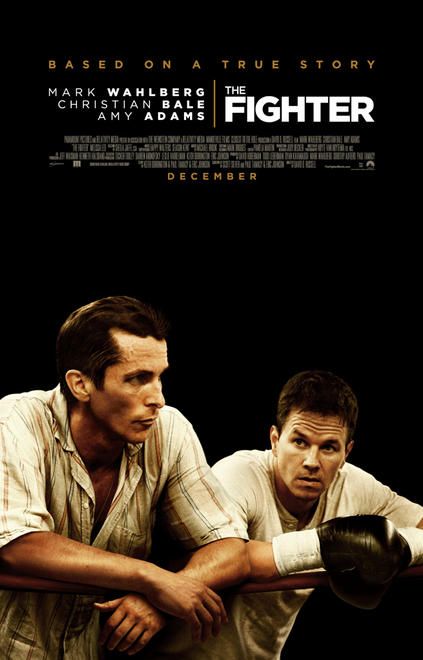
Man on Film: The Fighter

Do not take the fact that it has taken me over a month to write this as an indicator of how I felt about this film. In short, I loved The Fighter. Call me a sucker for sports movies if you would like to--the label may be apt--but David O. Russell's newest teaming with Mark Wahlberg, just leaves me excited for their fourth team-up, an adaptation of the video game Uncharted: Drake's Fortune*. 

*While the game is pretty awesome, I for one am a bit leery about a video game adaptation. According to the article above Wahlberg states
The idea that [Russell] has is just insane. So hopefully we’ll be making that movie this summer.
I know Max Payne (and well, just about every other video game movie, for that matter) sucked, but this is David O. Russell we're talking about here. 

In The Fighter, Wahlberg stars as the mismanaged boxer, Micky Ward, whose career has been undermined by his brother and mother. He has been exploited by a family that has been leeching off of him for years. His brother, Dicky Eklund, is played by Christian Bale, who has rightfully been nominated for Best Supporting Actor for the upcoming Oscars. Dicky is a crackhead who has slipped into the gutter. Once, he had a shot at the belt against Sugar Ray Leonard, but he has ceded control of his life to addiction.

Melissa Leo (The Three Burials of Melquiades Estrada, Homicide: Life on the Street, and Treme) plays his mother/manager, Alice Ward, who treats Micky as her meal ticket as much as her son and has a blind spot for her fuck-up of a son, Dicky. Both she and Amy Adams have been nominated for Best Supporting Actress for their turns. Adams plays Micky's sassy bartender girlfriend Charlene Fleming, who pushes him to look out for himself rather than continuing to put his dysfunctional and selfish family before his own needs.

As with really any David O. Russell film, The Fighter is primarily character-driven. This is clearly Russell's bread-and-butter. Yes, the stories are ineresting for the most part, but his films' success owe largely to their performances. This is no exception. The characters are vivid and flawed. Across the board, David O. Russell manages to get full realization of these characters from his actors, especially from Bale and Leo, both of whom disappear into their characters.

Speaking in purely narrative terms, this film bears a strong resemblance to Rocky. This is not a bad thing. It doesn't feel derivative. They are different films. Where Rocky Balboa is on his own in Rocky, Micky Ward is hindered by his family. There is also the mob element that is not present in The Fighter. Ultimately, though it is about an extreme underdog who had been down on their luck, who gets a shot at the belt and shows well.

On an emotional level, it seems impossible to me that you would not be drawn in. It is hard not to root for Micky. Coming out of the movie, both Mark and I were pumped up beyond belief. Even with some asshole lady behind me (I actually had to raise a card at the Alamo for the first time ever--and this was after telling her to "shut the fuck up" twice), I was thoroughly engrossed and invested in Micky's success/failure.

Again, maybe I'm a whore for sports movies, but The Fighter was great, easily one of my five favorite movies from this Oscar year.
Related Posts Plugin for WordPress, Blogger...